

Why Healthcare Organizations Replace Legacy ePrescribing Platforms Instead of Upgrading Them
Healthcare organizations replace legacy ePrescribing platforms when incremental upgrades become barriers to interoperability, regulatory compliance, scalability, and future innovation. Modern platforms simplify integration, reduce architectural complexity, and create a stronger foundation for AI, automation, and next-generation healthcare workflows.
✔ Legacy platforms eventually become architectural bottlenecks.
✔ Incremental upgrades often solve today’s problems while increasing tomorrow’s complexity.
✔ Modern platforms improve interoperability, compliance, and scalability.
✔ Replacement is ultimately a business decision, and not simply a technology upgrade.
For many healthcare organizations, replacing an ePrescribing platform isn’t even on the strategic roadmap until it suddenly becomes unavoidable.
On the surface, everything appears to be working.
– Prescriptions are flowing.
– Physicians aren’t raising concerns.
– The platform has been upgraded several times over the years.
– IT teams have become experts at keeping it running.
Then something changes.
– A new interoperability requirement arrives.
– Clinical teams ask for real-time prescription benefit checks.
– Pharmacy partners expect modern transaction standards.
– Leadership wants to introduce AI-powered clinical workflows.
What once seemed like a stable platform suddenly became the biggest obstacle to innovation.
Here’s what many CIOs, CTOs, and CMIOs eventually realize:
That distinction changes everything.
The Hidden Cost of “Just One More Upgrade”
When organizations talk about modernizing legacy systems, the default assumption is usually the same: “Let’s upgrade what we already have.”
On paper, it sounds like the lower-risk decision. After all, upgrading appears less disruptive than replacing an entire platform. But healthcare technology rarely works that way.
Each incremental upgrade often introduces another layer of customization, another integration to maintain, and another workaround for a workflow the original platform was never designed to support.
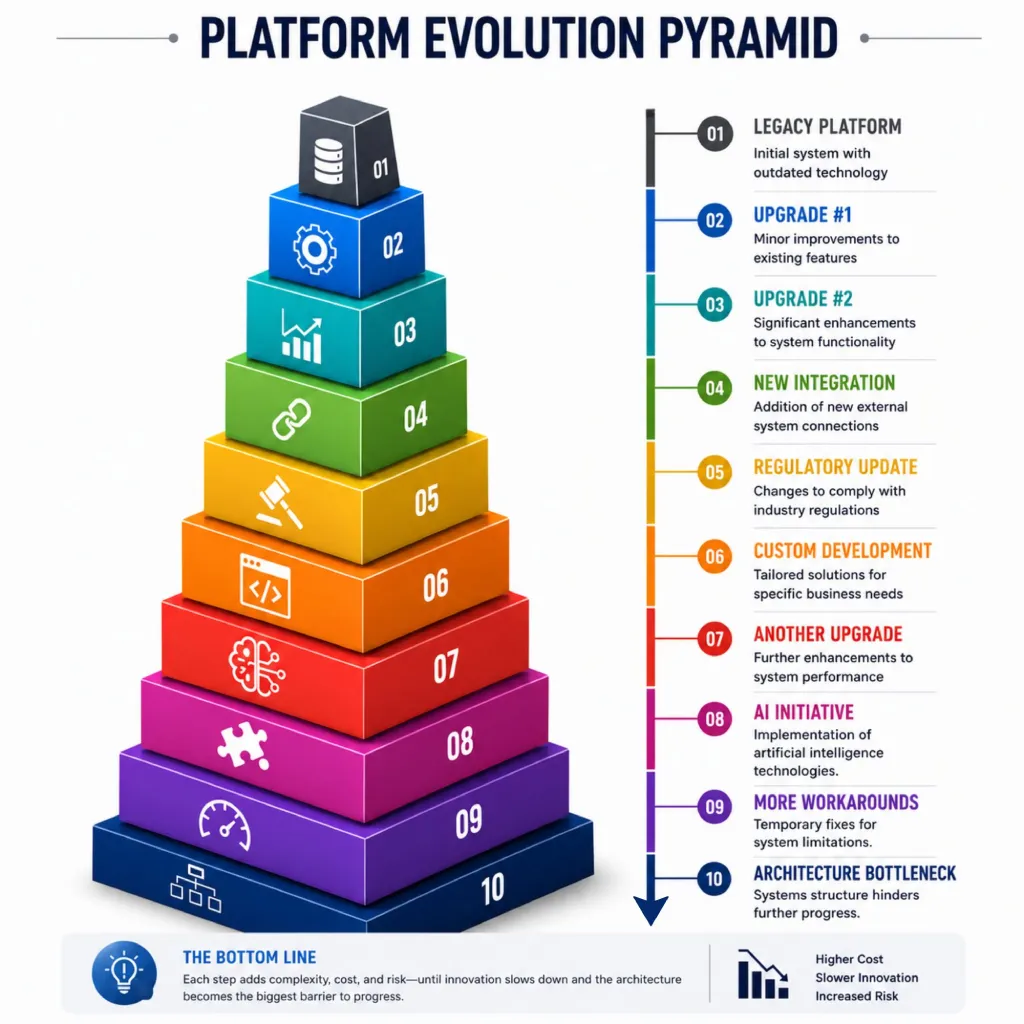
Over time, these incremental improvements create something much harder to manage, which is “architectural debt.”
Unlike technical debt, which developers encounter in code, architectural debt affects the entire organization. It slows integration projects, complicates regulatory updates, limits scalability, and increases the effort required for every future initiative.
In simple terms, every new project becomes more expensive than the last, which is not because the project itself is difficult but because the underlying platform resists change.
Modern Healthcare Is Moving Faster Than Legacy Platforms
Electronic prescribing has evolved significantly over the last decade. Today, organizations are expected to support capabilities that barely existed when many legacy platforms were originally designed, including:
- Electronic Prior Authorization (ePA)
- Real-Time Prescription Benefit (RTPB)
- Comprehensive Medication History
- Electronic Prescribing for Controlled Substances (EPCS)
- Seamless PBM connectivity
- Modern NCPDP SCRIPT standards
- Secure interoperability across EHRs, pharmacies, and payers
The regulatory landscape continues to evolve as well. CMS has finalized newer NCPDP SCRIPT standards that will replace older versions, reinforcing the industry’s move toward more modern prescription and medication-related transactions over the coming years.
Meanwhile, the volume of digital prescribing continues to grow.
According to the 2024 Surescripts Annual Impact Report, the Surescripts Network processed 27.2 billion health intelligence transactions and supported 2.6 billion electronic prescriptions in a single year.
The same report also notes growing adoption of real-time prescription benefit capabilities that help clinicians identify lower-cost medication options during prescribing. Those numbers tell an important story.
Healthcare organizations aren’t simply exchanging prescriptions anymore. They are exchanging medication histories, benefit information, prior authorizations, clinical intelligence, and patient-specific data, all in real time.
Legacy platforms designed primarily to transmit prescriptions now have to support an increasingly connected healthcare ecosystem. That’s a fundamentally different challenge.
“A legacy ePrescribing platform doesn’t limit innovation because it’s old. It limits innovation because every new capability has to negotiate with yesterday’s architecture.”
5 Signs It May Be Time to Replace Legacy Platforms Instead of Upgrading
5 indicators that suggest continued upgrades to legacy platforms may no longer deliver meaningful value.
1. Every new integration becomes a custom project
If connecting to a PBM, pharmacy partner, or new EHR requires months of custom development, the platform is likely limiting future agility rather than enabling it.
2. Regulatory updates consume disproportionate effort
Healthcare regulations are evolving constantly. If compliance initiatives consistently require extensive redevelopment instead of configuration, the architecture may have reached its practical limits.
3. Clinical workflows rely on manual workarounds
When clinicians must leave their prescribing workflow to access medication history, verify benefits, or manage prior authorizations, technology is creating friction instead of removing it.
That hidden operational effort rarely appears on a budget report, but clinicians experience it every day.
4. Innovation depends on legacy constraints
Many healthcare organizations want to introduce AI-assisted clinical decision support, automation, or advanced analytics.
Yet these initiatives often stall because the prescribing platform cannot expose data, integrate cleanly, or support modern APIs without significant redevelopment.
The limitation isn’t AI. It’s the platform beneath it.
5. IT teams spend more time maintaining than improving
Perhaps the clearest signal is this: When your best engineers spend more time preserving yesterday’s architecture than building tomorrow’s capabilities, modernization has become a business conversation, and not just an IT conversation.
Upgrading to Legacy Platform vs. Replacing with a Modern Platform
Here’s a side-by-side comparison of extending a legacy platform versus adopting a modern ePrescribing platform.
| Decision Criteria | Upgrade Legacy Platform | Replace with Modern Platform |
| Time to Deliver New Capabilities | Slow due to tightly coupled architecture and custom interfaces | Faster with modular services, API-first design, and reusable components |
| Compliance & Regulatory Readiness | Patchwork improvements with recurring compliance gaps | Built-in support for EPCS, audit requirements, and evolving regulatory standards |
| Interoperability | Point-to-point integrations and limited FHIR support | API-first, FHIR-enabled architecture with easier partner integration |
| Scalability & Resilience | Vertical scaling with higher outage risk and infrastructure constraints | Cloud-native architecture, horizontal scaling, and improved reliability |
| Total Cost of Ownership (3–5 Years) | Unpredictable due to emergency fixes, customizations, and specialized support | More predictable costs with standardized architecture and lower maintenance overhead |
| Clinician Experience | Outdated workflows, longer training, and higher support dependency | Modern user experience, streamlined workflows, and faster adoption |
| Innovation Readiness | AI, automation, and analytics require extensive customization | Built to support AI, automation, analytics, and future digital health initiatives |
| Business Agility | Every enhancement becomes progressively harder to implement | New capabilities can be delivered faster with less operational disruption |
Therefore, replacing a legacy platform shifts IT effort from maintaining the past to enabling future innovation.
What Modern ePrescribing Platforms Make Possible
Replacing a legacy ePrescribing platform isn’t about getting a newer interface or moving to the latest technology stack. It’s about creating a foundation that supports how healthcare is evolving.
Modern platforms are built to do more than route prescriptions. They enable organizations to connect clinical, operational, and financial workflows in ways that legacy architectures simply weren’t designed to support.
For healthcare leaders, that translates into measurable business outcomes, including:
- Faster interoperability with EHRs, pharmacies, PBMs, and third-party healthcare applications.
- Improved clinician experience by embedding medication history, benefit checks, and prior authorization into a single workflow.
- Reduced operational overhead by eliminating custom integrations that require continuous maintenance.
- Greater scalability to accommodate acquisitions, new care models, and expanding provider networks.
- Future-ready architecture that can support AI, automation, analytics, and evolving regulatory standards without requiring another major overhaul.
In other words, replacing the platform removes the friction that has been slowing every initiative built on top of it.
Modernization Is a Business Decision, Not an IT Project
Many modernization initiatives begin with technology discussions like servers, APIs, cloud migration, or interoperability standards.
But the organizations that modernize successfully start somewhere else.
They ask a different question: “Is our current platform helping the business move faster or forcing every new initiative to work around yesterday’s decisions?”
That’s an executive conversation.
Because the cost of a legacy platform isn’t measured only by maintenance expenses. It’s reflected in:
– Delayed product launches
– Slower regulatory compliance
– Clinician frustration
– Integration bottlenecks
– Missed opportunities to improve patient care
This is where many organizations discover that continuing to upgrade a legacy platform actually introduces more risk than replacing it.
The technology still functions, but the business doesn’t move!
How to Modernize Without Disrupting Clinical Operations
One of the biggest reasons healthcare organizations postpone replacement is the fear of disruption.
It’s understandable. Prescribing workflows are mission-critical, and even minor interruptions can affect clinicians, pharmacies, and ultimately patients. Fortunately, modernization doesn’t have to be an all-or-nothing event.
Successful organizations typically follow a phased approach:
1. Assess the current ecosystem
Go beyond infrastructure to evaluate integrations, workflow dependencies, customizations, compliance requirements, and user experience to understand where the platform is creating operational friction.
2. Prioritize business outcomes
Instead of replacing technology for its own sake, define what success looks like. Is the goal faster prior authorization? Better interoperability? Improved provider productivity? Lower maintenance costs? Aligning modernization with measurable outcomes keeps the initiative focused.
3. Modernize incrementally
Many organizations reduce implementation risk by modernizing capabilities in phases rather than replacing every component simultaneously. This allows critical clinical operations to continue while new functionality is introduced strategically.
4. Build for what’s next
Healthcare technology will continue to evolve. Whether it’s AI-assisted prescribing, expanded interoperability requirements, or new regulatory mandates, the next platform should be flexible enough to adapt without requiring another major transformation in a few years.
The Executive Takeaway
Healthcare organizations don’t replace legacy ePrescribing platforms because they’re old. They replace them because every upgrade eventually reaches a point of diminishing returns.
When every integration requires custom development, every compliance update becomes a major project, and every innovation depends on workarounds, the platform has shifted from being an operational asset to an organizational constraint. That’s the real inflection point.
The question is no longer whether the platform can process prescriptions. It’s whether it can support the next decade of healthcare transformation.
For CIOs, CTOs, and CMIOs, that makes modernization far more than a technology initiative. It’s an investment in clinical agility, operational efficiency, and long-term enterprise resilience.
How Logisolve Helps Healthcare Organizations Modernize with Confidence
Modernizing an ePrescribing platform requires more than technical implementation expertise. It demands a deep understanding of healthcare workflows, interoperability standards, regulatory requirements, and the operational realities of providers, payers, PBMs, and pharmacy ecosystems.
Logisolve partners with healthcare organizations to modernize legacy ePrescribing environments through a business-first approach delivering ePrescribing solutions that improve interoperability, streamline workflows, and support long-term healthcare innovation.
From platform assessments and interoperability strategy to integration, workflow optimization, and modernization planning, our teams help organizations reduce implementation risk while building a foundation for future innovation.
Whether you are evaluating your current architecture or planning the next phase of modernization, the right strategy can help you move beyond incremental upgrades and create an ePrescribing ecosystem that’s future-ready.
Ready to evaluate whether your current ePrescribing platform is enabling innovation or holding it back?
Connect with Logisolve’s healthcare experts to explore a modernization strategy tailored to your organization’s goals.
FAQs
What business benefits does a modern ePrescribing platform provide?
Modern ePrescribing platforms improve interoperability, streamline clinician workflows, reduce manual processes, simplify regulatory compliance, and provide a scalable foundation for AI, analytics, and future healthcare innovations. The benefits extend beyond IT by improving operational efficiency and patient care.
How does interoperability influence ePrescribing modernization?
Interoperability enables secure data exchange between EHRs, pharmacies, PBMs, payers, and other healthcare systems. Modern platforms built on current interoperability standards reduce integration effort and improve the flow of medication-related information across the care continuum.
Can AI initiatives succeed on top of a legacy ePrescribing platform?
AI can deliver value only when supported by modern, accessible, and interoperable data. Legacy platforms with fragmented architectures and limited integration capabilities often become barriers to AI adoption rather than enablers of innovation.
What should CIOs evaluate before replacing an ePrescribing platform?
Healthcare leaders should assess platform architecture, interoperability capabilities, regulatory readiness, scalability, integration complexity, clinician experience, and the platform’s ability to support future digital health initiatives.
How can Logisolve help healthcare organizations modernize legacy ePrescribing platforms?
Logisolve helps healthcare organizations modernize legacy ePrescribing environments by combining healthcare domain expertise with enterprise architecture and interoperability experience. From platform assessments and modernization roadmaps to workflow optimization and system integration, Logisolve enables organizations to reduce implementation risk while building a scalable, future-ready prescribing ecosystem.