

Medication History Gaps Are Increasing Clinical Risk: How Leading Healthcare Organizations Are Responding
Medication history gaps are slowly growing to become a patient safety concern. Though healthcare organizations collect medication data from multiple sources, clinicians cannot take treatment decisions without having a comprehensive view of patients’ medication history.
To address these challenges, leading healthcare organizations are modernizing medication history solutions by improving interoperability, automating reconciliation, and embedding medication intelligence into clinical workflows.
- Medication history gaps emerge due to fragmented data across EHRs, pharmacies, PBMs, and external healthcare providers.
- Inaccurate medication histories contribute to medication errors, adverse drug events, and extra workload on clinicians.
- Leading healthcare organizations are improving patient safety by modernizing medication history solutions and embedding reconciliation into clinical workflows.
- Technology alone is not enough. Successful organizations combine interoperability, workflow optimization, and governance to improve the accuracy of medication histories.
- Modern medication history capabilities create a stronger foundation for safer patient care, better clinical decisions, and future digital transformation initiatives.
Why Do Medication History Gaps Persist Despite Existing Data?
Medication history gaps persist because medication information is often fragmented across EHRs, pharmacies, specialists, and external healthcare systems rather than missing altogether. Although most healthcare organizations can access patients’ medication records, they hardly present a complete view of a patient’s medication journey.
- A medication list captured during admission may omit prescriptions filled at an outside pharmacy.
- Medications prescribed by specialists may never reach the primary electronic health record (EHR).
- Patients may forget doses, stop taking medications without informing clinicians, or simply forget information about the use of drugs.
By the time clinicians begin treatment, they are often making decisions using incomplete or outdated information, increasing the risk of medication errors and compromising patient safety.
According to the World Health Organization (WHO), medication-related errors cause at least one death every day and injure approximately 1.3 million people annually in the United States, while the global cost associated with medication errors is estimated at $42 billion each year.
For healthcare IT leaders and product teams, the situation presents an important challenge. The goal is no longer just collecting medication information; it is ensuring clinicians have access to a complete, accurate, and actionable medication history when clinical decisions are made.
Why Medication History Gaps Increase Clinical Risk
Medication history gaps increase clinical risk because clinicians cannot safely prescribe therapies, identify drug interactions, or manage chronic conditions without complete medication information.
The Agency for Healthcare Research and Quality (AHRQ) notes that medication discrepancies occur frequently during care transitions, particularly at hospital admission and discharge. These discrepancies can lead to duplicate therapies, omitted medications, dosing errors, and preventable adverse drug events if they are not identified through effective medication history reconciliation.
Research published in BMJ Quality & Safety has also found that medication history errors occur in a significant proportion of hospitalized patients, with omissions representing the most common type of discrepancy.
Did You Know?
Medication discrepancies frequently originate before clinicians begin treatment, making accurate medication history one of the earliest opportunities to improve patient safety.
The challenge is growing as healthcare delivery becomes increasingly distributed.
Today’s patients receive care across specialists, pharmacies, telehealth providers, hospitals, and outpatient settings. Each transition increases the likelihood that medication information becomes inconsistent or incomplete.
For healthcare IT directors and product leaders, medication history has evolved from a documentation task into an interoperability challenge that directly influences clinical outcomes.
5 Warning Signs Your Medication History Process Is Increasing Clinical Risk
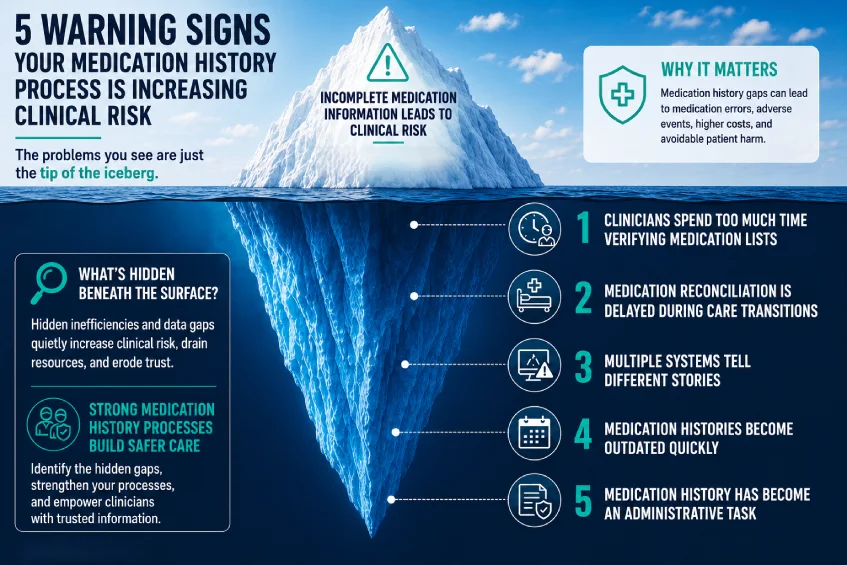
Medication history problems surface through recurring operational inefficiencies that gradually increase clinical risk. Recognizing these warning signs early allows healthcare organizations to address underlying process and technology gaps before they impact patient safety.
If any of the following scenarios sound familiar, your organization may have opportunities to strengthen its medication history reconciliation process.
1. Clinicians Spend Too Much Time Verifying Medication Lists
When physicians, nurses, or pharmacists routinely call pharmacies, interview patients multiple times, or manually compare medication lists across systems, valuable clinical time is diverted from patient care.
Manual verification may resolve immediate discrepancies, but it is neither scalable nor sustainable in today’s fast-paced healthcare environment.
2. Medication Reconciliation Is Delayed During Care Transitions
Admission, discharge, and transfers remain the highest risk points for medication discrepancies.
If medication history reconciliation consistently occurs late in the care process or relies heavily on manual intervention, organizations increase the likelihood of omitted medications, duplicate therapies, and treatment delays.
3. Multiple Systems Tell Different Stories
A patient’s EHR, pharmacy records, and specialist documentation should reinforce one another but not contradict each other.
When clinicians encounter conflicting medication information across different systems, confidence in the data declines, forcing additional verification before treatment decisions can be made.
4. Medication Histories Become Outdated Quickly
Medication information changes continuously. So, patients begin new therapies, discontinue medications, adjust dosages, or receive prescriptions from new providers. Static medication lists quickly lose value if they are not continuously refreshed using reliable external data sources.
5. Medication History Has Become an Administrative Task Instead of a Clinical Asset
When medication history is viewed primarily as documentation for regulatory compliance instead of a trusted source for clinical decision-making, organizations miss opportunities to improve safety, reduce clinician burden, and enhance patient outcomes.
Forward-looking healthcare organizations increasingly recognize medication history as a strategic clinical capability rather than a routine documentation requirement.
How Leading Healthcare Organizations Are Closing Medication History Gaps
Leading healthcare organizations are reducing medication history gaps by combining interoperability, workflow optimization, and automation to provide clinicians with more complete and reliable medication information at the point of care.
Rather than asking clinicians to compensate for incomplete data through manual verification, forward-looking organizations are redesigning how medication information is collected, validated, and maintained throughout the patient’s journey.
Five practices distinguish organizations that have successfully modernized medication history management.
1. Connect Medication Data Across the Care Ecosystem
Leading organizations integrate medication data from EHRs, pharmacies, PBMs, HIEs, and other trusted sources to create a unified, longitudinal medication record.
2. Automate Medication History Retrieval
Rather than depending entirely on patient interviews, leading organizations use ePrescribing solutions to retrieve available prescription medication history electronically before patient encounters.
This enables clinicians to begin medication history reconciliation with a more complete baseline, reducing manual effort while improving accuracy.
3. Embed Medication Intelligence into Clinical Decision-Making
Having a unified medication history is only the first step. To improve patient care, clinicians must be able to review, verify, and reconcile medications within the workflows they already use. Leading organizations embed medication history directly into prescribing, admission, discharge, and care transition workflows, reducing unnecessary clicks and supporting faster clinical decisions.
4. Standardize Reconciliation Processes
Organizations that establish standardized medication history reconciliation workflows supported by clear governance, defined roles, and consistent clinical protocols are better positioned to reduce medication discrepancies across departments and care settings. Standardization helps ensure reconciliation is performed consistently, regardless of where or when care is delivered.
5. Continuously Measure and Improve Performance
Leading healthcare organizations treat medication history as an ongoing capability rather than a one-time project. They continuously monitor reconciliation accuracy, clinician adoption, workflow efficiency, and patient safety outcomes to identify opportunities for improvement. This continuous optimization helps ensure medication history remains a strategic asset that supports both clinical excellence and long-term digital transformation.
Why Technology Alone Won’t Solve Medication History Reconciliation
Modern medication history solutions improve accuracy, but lasting results require interoperable systems, standardized workflows, and clinician adoption.
Leading healthcare organizations increasingly approach medication history modernization as an enterprise initiative rather than a standalone IT project. Organizations often combine technology investments with healthcare consulting to align clinical workflows, governance, and interoperability, improving patient safety while supporting broader digital transformation initiatives.
Organizations that modernize medication history capabilities today also create the interoperability foundation needed for future digital health initiatives, including advanced clinical decision support and more connected models of care.
How Logisolve Helps Healthcare Organizations Modernize Medication History Solutions
Healthcare organizations need a strategy that connects medication data, supports clinical workflows, and integrates seamlessly with existing healthcare systems.
Logisolve partners with healthcare organizations to develop interoperable medication history solutions that improve data accessibility, streamline medication reconciliation, and equip clinicians with more complete and reliable medication information at the point of care.
By modernizing legacy healthcare platforms and building scalable, standards-based solutions, Logisolve helps organizations strengthen clinical decision-making, improve operational efficiency, and accelerate long-term digital transformation.
FAQs
What is medication history reconciliation?
Medication history reconciliation is the process of comparing a patient’s current medication history with physician orders during transitions of care. The goal is to identify and resolve discrepancies that could lead to medication errors or adverse drug events.
How can healthcare organizations improve the accuracy of medication histories?
Healthcare organizations can improve medication history accuracy by integrating data from trusted sources, automating medication history retrieval, and embedding reconciliation into clinical workflows. Standardized processes, interoperability, and regular data validation also help ensure clinicians have access to complete and reliable medication information.
What causes medication history gaps?
Medication history gaps often result from fragmented healthcare systems, disconnected pharmacy data, incomplete patient information, inconsistent documentation practices, and limited interoperability between healthcare applications.
How do medication history solutions improve patient safety?
Modern medication history solutions aggregate medication information from multiple trusted sources, automate data retrieval, and support accurate medication history reconciliation. This reduces medication discrepancies and helps clinicians make informed prescribing decisions.
What should healthcare organizations consider before modernizing legacy clinical applications?
Before modernizing legacy systems, organizations should evaluate interoperability requirements, scalability, data security, regulatory compliance, integration complexity, and the impact on clinical workflows. A clear modernization strategy helps reduce implementation risks while supporting long-term digital transformation goals.