

Integration Debt Is the New Technical Debt in Healthcare IT
Healthcare organizations can accumulate integration debt when years of point-to-point interfaces, custom mappings, legacy connections, and workarounds make systems increasingly difficult and expensive to change.Like technical debt, integration debt may not appear as a single line item, but its cost shows up in:
- Slower projects
- Fragile workflows
- Higher maintenance effort
- Rising costs
- Limited ability to adopt new technology
- Increased operational risk
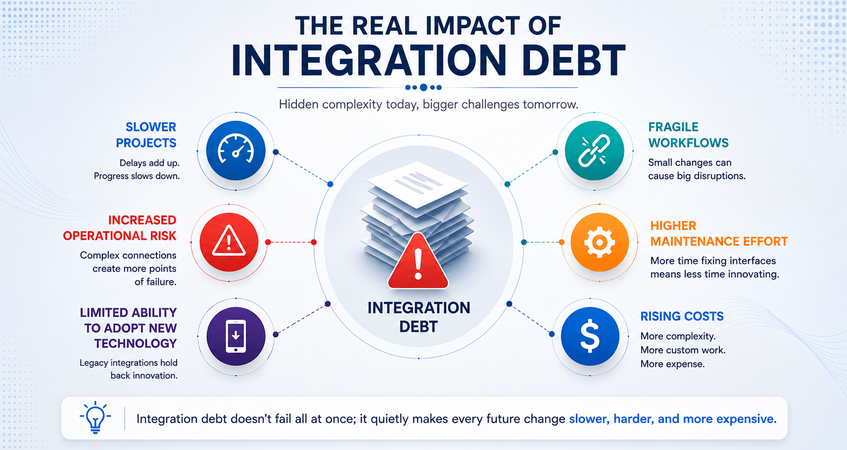
The problem is growing as healthcare ecosystems become more connected. Electronic Health Record (EHRs), pharmacies, payers, Pharmacy Benefit Managers (PBMs), clinical applications, patient platforms, and analytics systems all need to exchange information. Every new connection can solve an immediate business need while quietly adding another dependency to the architecture.
For healthcare IT Directors and Product Leaders, the question is no longer simply whether systems are integrated. It is whether those integrations are helping the organization move forward or making every future change harder.
Key Takeaways
- Integration debt accumulates when healthcare organizations rely on fragmented, custom, or difficult-to-maintain connections between systems.
- Its impact appears through rising maintenance effort, slower delivery, brittle workflows, and barriers to modernization.
- Healthcare interoperability is improving, but access to data does not always translate into effective use at the point of care.
- Reducing integration debt requires more than replacing interfaces; it requires an intentional modernization and interoperability strategy.
- Healthcare leaders should treat integration architecture as a long-term business capability rather than an IT maintenance concern.
What Is Integration Debt in Healthcare IT?
Integration debt is the accumulated complexity created when healthcare systems depend on aging, duplicated, custom, or poorly governed integrations that become increasingly difficult to maintain or replace.
A single interface rarely creates a problem. The issue develops over time.
An organization may add an interface to connect an acquired application, another to support a pharmacy partner, and another to meet a regulatory requirement. Over time, these connections can create the same kind of architectural constraints seen in legacy ePrescribing environments, where every new enhancement adds another dependency to maintain.
That complexity becomes a form of debt because every future change must account for what already exists.
Is Integration Debt Becoming a Bigger Healthcare IT Problem?
Integration debt is becoming more significant because healthcare organizations are exchanging more information across increasingly complex technology ecosystems while continuing to operate legacy applications.
That gap matters. Data can technically move between systems and still fail to create a useful clinical or operational workflow.
Integration debt is one reason that goal can be difficult to achieve.
How to Identify Integration Debt in Your Healthcare Environment
Integration debt becomes visible when existing connections start creating more work than value through repeated troubleshooting, manual workarounds, slow onboarding, and costly changes.
Healthcare IT Leaders can look for several warning signs:
1. Integrations Require Frequent Manual Intervention
When integrations regularly require IT teams to troubleshoot failed transactions, reconcile data manually, or intervene in routine workflows, the underlying architecture may be carrying too much complexity. Repeated intervention increases maintenance effort and makes it harder to scale operations efficiently.
2. Connections Depend on Outdated Technologies
Legacy protocols, undocumented business logic, and aging interface technologies can make even minor changes difficult to implement. Over time, teams may become dependent on a small number of people who understand how these connections work, creating additional operational risk.
3. Systems Maintain Different Versions of the Same Data
When multiple applications maintain conflicting or duplicated versions of the same information, teams spend more time determining which record is accurate. This can create downstream problems for reporting, clinical workflows, and data exchange between connected systems.
4. New Applications Require Significant Custom Development
If onboarding a new application, provider, pharmacy, payer, or technology partner consistently requires extensive custom development, the existing integration architecture may be limiting growth. A scalable environment should make new connections easier to establish without rebuilding the same integration logic repeatedly.
5. Regulatory Changes Trigger Expensive Integration Work
When a new regulatory requirement or industry standard forces major interface changes, integration debt becomes a business concern rather than just an IT issue. Organizations with tightly coupled or heavily customized integrations may face longer implementation cycles, higher costs, and greater operational disruption.
These indicators matter because integration debt rarely announces itself as one major failure. It accumulates through small architectural compromises until routine changes become expensive, slow, or risky.
The financial impact of accumulated technical debt helps explain why these warning signs deserve attention. Research published in the Journal of Systems and Software notes that 25% of development effort can be spent addressing issues caused by technical debt.
Integration debt can compound these challenges in healthcare, where legacy technology often creates additional complexity across connected systems.
A Practical Roadmap for Reducing Integration Debt
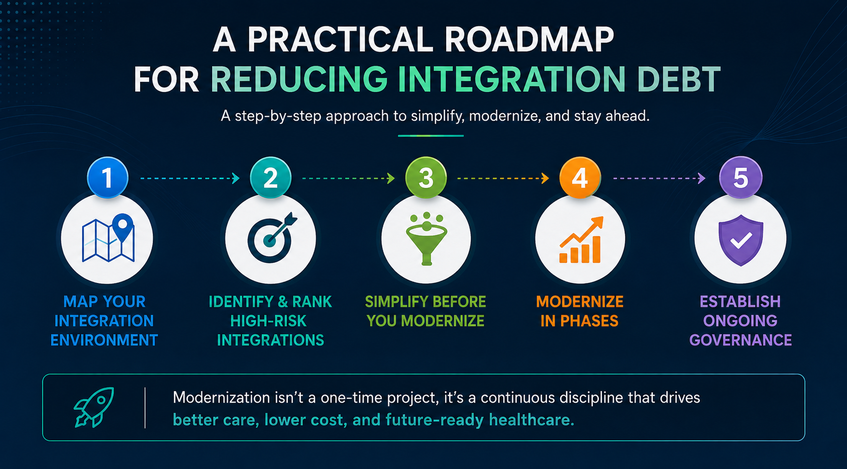
Reducing integration debt starts with understanding where complexity exists, prioritizing the highest-risk connections, and modernizing them in manageable phases rather than attempting to replace everything at once.
1. Map Your Integration Environment
Start by documenting the interfaces, applications, data flows, dependencies, technologies, and ownership across the environment. The goal is to identify which integrations are critical, duplicated, outdated, or difficult to maintain.
2. Identify and Rank High-Risk Integrations
Not every integration needs immediate attention. Prioritize connections that frequently fail, require manual intervention, depend on unsupported technologies, or create significant operational, clinical, or regulatory risk.
3. Simplify Before You Modernize
Look for duplicated interfaces, unnecessary connections, outdated middleware, and custom logic that can be consolidated or removed. Simplifying the landscape first prevents organizations from carrying old complexity into a modern architecture.
4. Modernize in Phases
Replace or refactor high-priority integrations in manageable stages rather than attempting a large-scale overhaul. A phased approach helps organizations maintain critical workflows while gradually improving scalability, interoperability, and maintainability.
5. Establish Ongoing Governance
Integration modernization should not end when a project goes live. Assign ownership, document dependencies, monitor transaction performance, and review new standards and technology changes regularly so integration debt does not begin accumulating again.
The impact of integration debt can be particularly visible in medication workflows. Medication history gaps provide a relevant example of how fragmented connections between EHRs, pharmacies, PBMs, and external providers can affect information availability and clinical workflows.
Healthcare IT Leaders should treat integration debt as an architectural and business risk that needs to be measured, prioritized, and reduced alongside other modernization initiatives. The organizations best positioned for the future will not necessarily have the newest systems; they will have an architecture that allows those systems to work together without creating another layer of integration debt.
How Logisolve Helps Reduce Integration Debt
Reducing integration debt requires both healthcare domain knowledge and the ability to work across complex technology environments.
Logisolve helps healthcare organizations assess complex application landscapes, modernize legacy platforms, and develop interoperable solutions across healthcare workflows. Its experience includes connecting EHRs, pharmacy systems, PBMs, and other healthcare applications while supporting compliance with National Council for Prescription Drug Programs (NCPDP) standards across prescription-related workflows.
For organizations looking to modernize prescription workflows, Logisolve’s ePrescribing solutions provide another path to reducing the integration burden around pharmacy connectivity and NCPDP-based transactions.
Ready to understand where integration debt is slowing your healthcare technology strategy?
FAQs
How is integration debt different from technical debt?
Technical debt generally refers to compromises or shortcuts within software that increase future maintenance costs. Integration debt is more specific to the connections between systems, including interfaces, mappings, middleware, dependencies, and data flows. The two often reinforce each other in complex healthcare environments.
Can integration debt affect patient care?
Yes. Integration debt can affect patient care when fragmented or unreliable connections prevent clinicians from receiving timely, complete, or usable information. The risk is not limited to system downtime; inefficient workflows and manual data handling can also delay decisions and increase operational burden.
Should healthcare organizations replace all legacy integrations?
No, replacing every legacy integration is rarely practical or necessary. Healthcare organizations should first identify which integrations create the greatest operational, security, scalability, or modernization risks and prioritize those connections based on business and clinical impact.
Does interoperability eliminate integration debt?
No, interoperability can reduce integration complexity, but simply exchanging data does not eliminate architectural debt. Healthcare organizations also need consistent standards, well-designed interfaces, clear governance, reliable data flows, and workflows that allow people and systems to use the exchanged information effectively.
When should integration debt become a modernization priority?
Integration debt should become a modernization priority when it starts slowing business initiatives, increasing maintenance costs, limiting interoperability, or making regulatory and technology changes difficult to implement. Waiting until integrations become critical failures usually makes modernization more disruptive and expensive.
How can a healthcare technology partner help reduce integration debt?
A healthcare technology partner can assess the existing integration landscape, identify high-risk dependencies, define a modernization roadmap, and implement changes in manageable phases. The right partner should combine integration expertise with healthcare domain knowledge so modernization supports clinical and business workflows rather than disrupting them.
What is the ROI of modernizing healthcare integrations?
The ROI comes from reducing maintenance costs, improving efficiency, reducing time to connect new systems, and lowering the risks of outdated technology. Modern architectures can also reduce manual work while improving scalability, reliability, and agility.
How can organizations estimate the business case for healthcare integration modernization?
Organizations can compare current integration costs with the expected costs and benefits of modernization. This includes maintenance, support, manual workarounds, failed transactions, onboarding delays, and regulatory changes, helping IT leaders prioritize high-impact integrations and measure expected outcomes.
When should healthcare organizations consider an integration platform instead of point-to-point interfaces?
Organizations should consider an integration platform when growing system connections make point-to-point interfaces difficult to manage or scale. A platform can centralize connectivity and monitoring while making it easier to add systems and partners without creating more integration debt.