

How Generative AI Is Transforming Healthcare Operations Beyond Chatbots
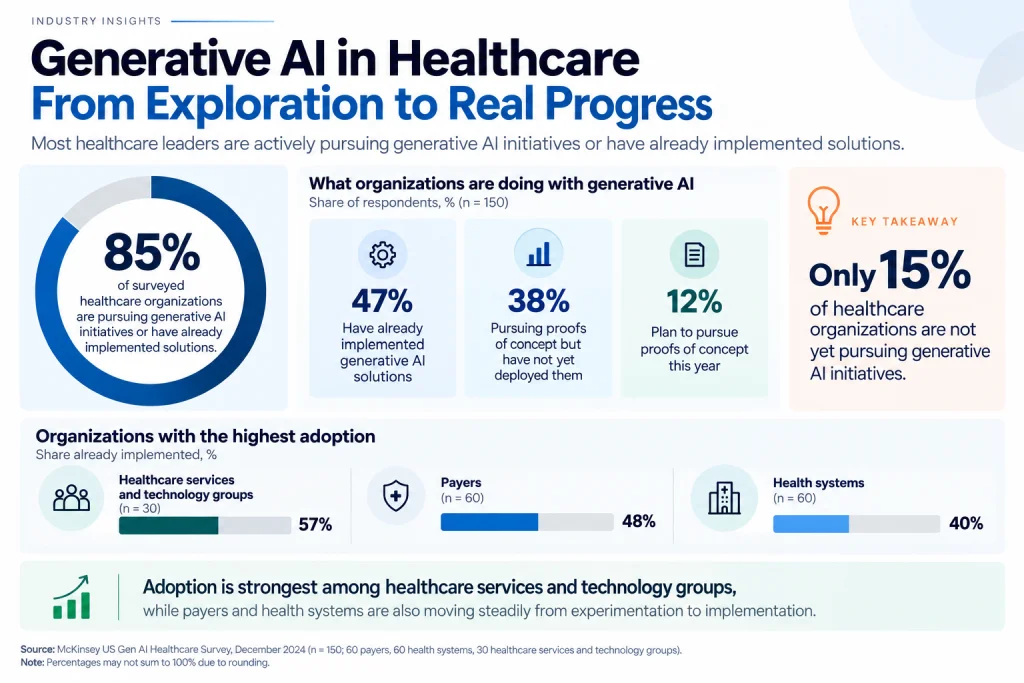
Healthcare organizations are moving generative AI beyond conversational interfaces and into the workflows that keep care delivery running. Chatbots answer questions. Operational AI helps move work forward by summarizing information, drafting documentation, retrieving knowledge, preparing work, and supporting decisions across clinical and administrative operations.
Key Takeaways
- Generative AI can reduce information-heavy work across healthcare teams.
- High-value use cases include documentation, prior authorization, knowledge retrieval, care coordination, and operational analysis.
- AI creates more value when connected to enterprise data and workflows rather than deployed as a standalone chatbot.
- Data quality, integration, governance, and human oversight remain essential for production use.
Key Generative AI Use Cases in Healthcare Operations
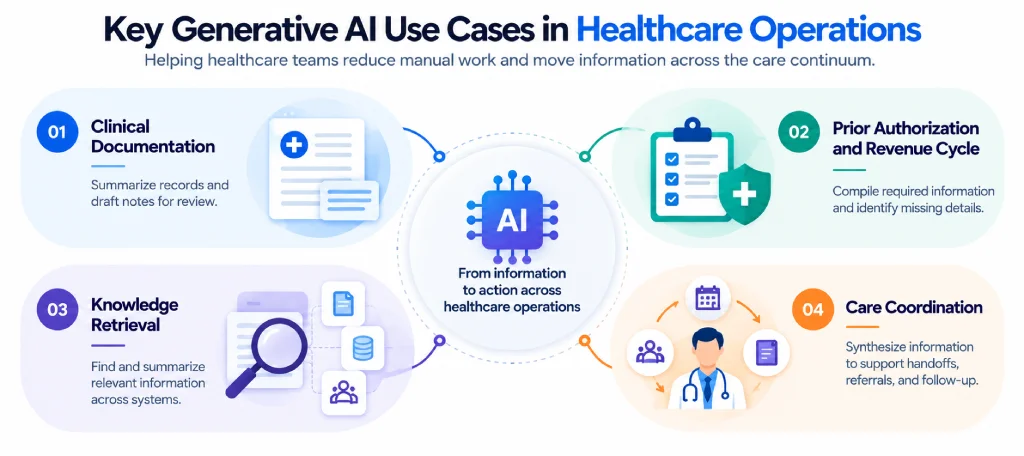
The most practical applications sit between people, information, and existing systems. They reduce the manual effort required to move work through a process.
Four operational areas stand out for healthcare organizations looking to move generative AI beyond conversational use cases.
1. Documentation Can Shift from Manual Drafting to Review
Generative AI can summarize records and draft discharge instructions, referral letters, progress notes, and other documents for human review.
The American Medical Association reported in 2025 that 80% of surveyed physicians considered AI support for billing codes, medical charts, or visit notes relevant to their practice. AI can handle an initial documentation pass while clinicians retain responsibility for review and final decisions.
2. Prior Authorization and Revenue Cycle Work Can Become More Intelligent
Generative AI can help assemble information for prior authorization, identify missing documentation, summarize relevant clinical information, and draft communications. Similar approaches can support coding, claims documentation, and denials management.
The value comes from reducing information retrieval and preparation, not from allowing AI to make unsupported coverage or clinical decisions. Google Cloud and The Harris Poll have also identified prior authorization as an area where healthcare professionals see potential for generative AI.
3. Healthcare Teams Can Find the Right Information Faster
Healthcare information sits across EHRs, policies, clinical documents, claims, pharmacy data, and other systems. Generative AI can provide a natural-language layer for retrieving and summarizing that information when the underlying data is appropriately connected and governed.
This process becomes harder when integration debt exists. A better interface cannot compensate for disconnected or poorly governed data.
4. Care Coordination Can Become More Context-Aware
Generative AI can synthesize information to help teams prepare for transitions of care, referrals, handoffs, and follow-up activities. It could summarize recent encounters, medications, outstanding tasks, and care-plan information for the next team member.
That does not eliminate reconciliation. Organizations addressing medication history gaps can use generative AI more effectively when medication information is complete, current, and traceable.
Generative AI in Healthcare: Benefits and Business Impact
The business impact of generative AI depends on where it is applied and how the workflow is designed. In healthcare operations, potential benefits include:
- Reducing administrative effort
- Shortening information-processing time
- Improving access to organizational knowledge
- Helping teams handle high-volume work more efficiently
The impact should be measured against the baseline of the existing workflow. Useful measures can include turnaround time, documentation effort, processing volume, rework, exception rates, and cost per transaction. For healthcare leaders, the objective is not simply to deploy AI, but to determine whether it produces a measurable improvement in the way work gets done.
Why Does Healthcare Generative AI Need More Than a Model?
A capable foundation model is only one component of an operational AI solution. The system also needs reliable data, secure access, workflow integration, monitoring, governance, and a clear human role.
Moving from experimentation to production depends on more than model capability. The use case, data, governance, integration, and workflow all influence whether an AI initiative can deliver value in a real healthcare environment.
Important Read: Why Healthcare AI Projects Fail Before the First Model Is Deployed
Integration is especially important. A chatbot outside the systems where work happens may demonstrate impressive capabilities while still leaving employees responsible for copying information between applications. A stronger approach connects AI to existing workflows, with appropriate access to the information and systems required for the task.
The right starting point is the workflow with the clearest operational need and measurable potential for improvement. The following criteria can help healthcare leaders prioritize that opportunity and determine whether it is ready to move toward production.
What Healthcare Leaders Should Evaluate Before Scaling
Before moving generative AI from experimentation toward production, healthcare organizations need a practical implementation path. The process should connect the use case to measurable outcomes while addressing data, workflow integration, human oversight, and ongoing performance.
5 areas can help healthcare leaders structure that transition.
1. Define a Measurable Use Case
Start with a specific workflow, baseline, user group, and expected outcome. A use case such as reducing documentation time or accelerating prior authorization preparation provides a clearer basis for evaluating whether generative AI is delivering meaningful improvement.
2. Assess Whether the Data Is Fit for Purpose
Generative AI needs access to information that is relevant, sufficiently accurate, and appropriate for the intended use. Healthcare organizations should assess the data supporting the workflow rather than assuming that having large volumes of data means the AI application is ready.
3. Connect AI to the Existing Workflow
An AI capability creates limited operational value if employees have to move information manually between disconnected systems. Leaders should determine how the AI solution will interact with the applications, data sources, and processes already used by the teams performing the work.
4. Define Human Oversight and Accountability
Healthcare workflows often involve decisions where human review remains essential. Organizations should establish where people review AI-generated content, when exceptions are escalated, and who remains accountable for the final action or decision.
5. Establish Ongoing Performance Monitoring
Performance should be evaluated beyond initial deployment. Healthcare organizations can monitor output quality, adoption, workflow efficiency, exceptions, security, and business outcomes to determine whether the AI application continues to perform as intended.
These considerations shift the conversation from “What can the model do?” to “Where can generative AI improve how the organization works?”
Logisolve helps healthcare organizations address the data, integration, architecture, and governance requirements involved in implementing enterprise technology solutions. Its health science solutions can support organizations working to connect systems, improve information flows, and establish the technical foundation needed to move AI initiatives toward production. The focus is on aligning technology implementation with the operational requirements and measurable outcomes of each initiative.
The Next Phase Is Operational, Not Conversational
Healthcare’s generative AI opportunity is expanding from chatbots to the operational fabric around care delivery. Strong implementations will connect AI to trusted information, established workflows, and measurable business or clinical objectives.
The goal is not to deploy generative AI everywhere. It is to identify where information-heavy work creates friction, determine whether AI can reduce that friction safely, and build the technical foundation to make the improvement repeatable.
FAQs
1. Can generative AI work with EHR data?
Yes, but access to EHR data does not automatically make an AI application reliable. Data quality, interoperability, security, permissions, workflow integration, and validation all need to be addressed before production use.
2. What healthcare workflows are best suited for generative AI?
Generative AI is generally well suited to workflows that involve large amounts of unstructured information, repetitive documentation, summarization, or content generation. Examples include preparing authorization documentation, summarizing records, drafting communications, and supporting knowledge retrieval.
3. How can healthcare organizations measure the ROI of generative AI?
ROI should be tied to the specific workflow rather than the AI model itself. Organizations can evaluate measures such as time saved, processing volume, turnaround time, rework, administrative effort, adoption, and cost per transaction. For higher-risk applications, quality, exception rates, and human-review requirements should also be included in the evaluation.
4. How can healthcare organizations scale generative AI beyond pilot projects?
Scaling generative AI requires moving from an isolated use case to a repeatable approach for data, integration, governance, human oversight, and performance monitoring. Organizations can start with a focused workflow, measure results against a defined baseline, and use those findings to determine where additional use cases can be deployed.
5. Can generative AI integrate with our existing healthcare systems?
Yes, generative AI can be integrated with systems such as EHRs and other healthcare applications when appropriate interfaces, data access, security controls, and workflow integration are in place. The goal is to bring AI into the systems where employees already work rather than creating another disconnected application.
6. How long does it take to implement generative AI in healthcare operations?
There is no standard implementation timeline because it depends on the use case, data readiness, integration requirements, security controls, and organizational complexity. A focused application may be implemented relatively quickly, while solutions requiring multiple system integrations, extensive validation, and enterprise-wide deployment can take considerably longer.
7. What does it cost to implement generative AI for a healthcare organization?
The cost depends on factors such as the AI solution, data preparation, system integration, infrastructure, security, validation, and ongoing monitoring. Rather than evaluating the technology cost alone, healthcare organizations should consider the total cost of implementation and operation against measurable improvements in the targeted workflow.
8. How can generative AI reduce administrative workload in healthcare?
Generative AI can reduce administrative workload by supporting tasks such as documentation, summarization, information retrieval, prior authorization preparation, claims-related work, and routine communications. By reducing repetitive information-processing tasks, AI can give healthcare teams more time for activities that require human judgment and direct patient interaction.