
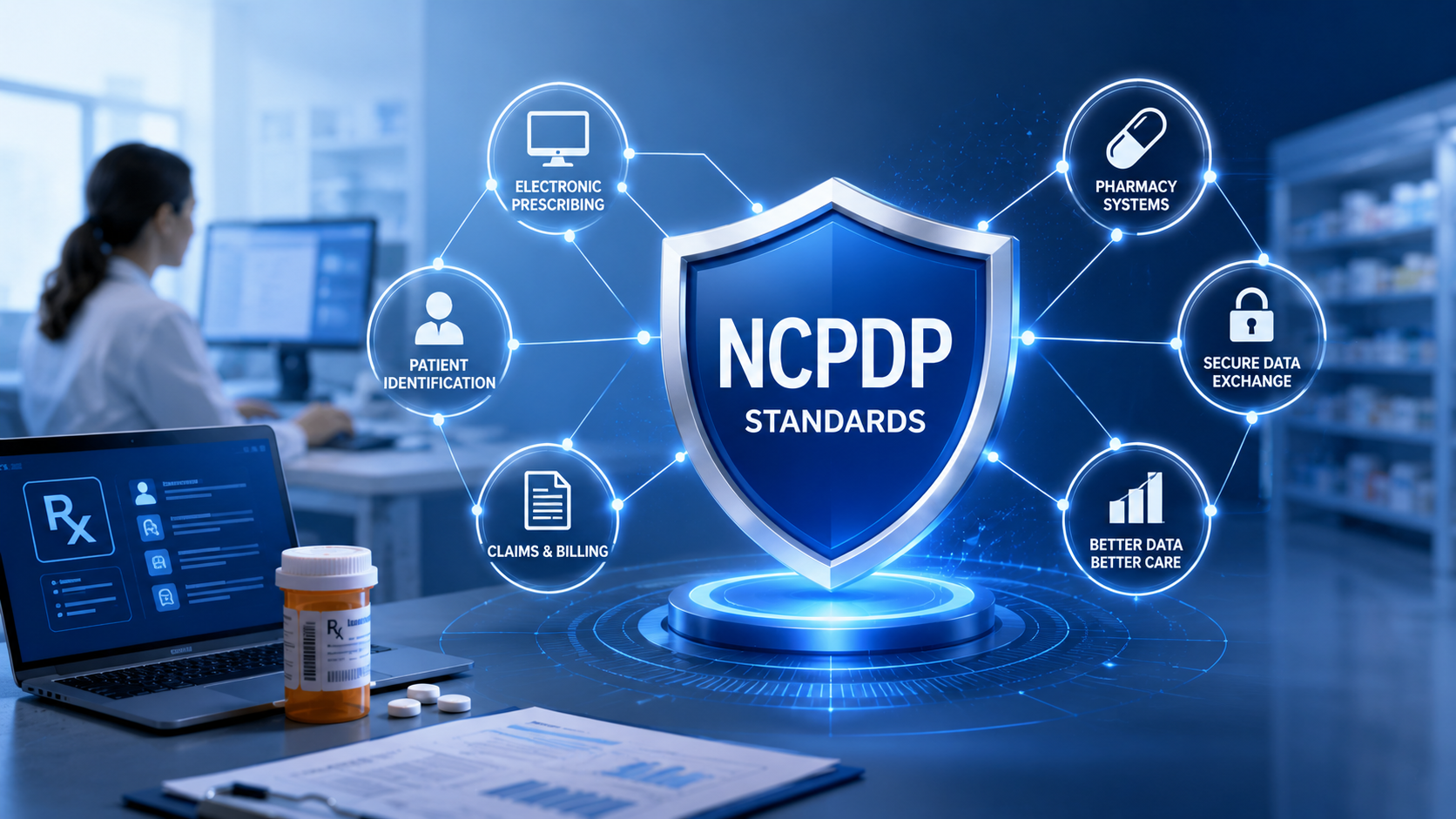
NCPDP Standards Explained: What Healthcare IT Leaders Need to Know
Healthcare organizations depend on National Council for Prescription Drug Programs (NCPDP) standards to exchange prescription information accurately and securely across prescribers, pharmacies, pharmacy benefit managers (PBMs), payers, and healthcare systems.
For healthcare IT directors and product leaders, these standards are far more than technical specifications; they influence interoperability, regulatory compliance, medication safety, and the ability to scale digital health initiatives without creating costly integration challenges.
Most healthcare IT leaders don’t think much about NCPDP standards until something disrupts a prescription workflow.
✔ A refill request fails to reach the pharmacy.
✔ A medication history transaction returns incomplete information.
✔ A new CMS requirement forces another round of system updates.
What initially appears to be an isolated technical issue often reveals a much bigger challenge: the organization’s inability to support standardized, reliable communication across its healthcare ecosystem.
As healthcare organizations modernize legacy applications and expand digital health capabilities, understanding NCPDP standards is no longer optional. It’s becoming a strategic requirement.
Key Takeaways
✔ NCPDP standards enable secure, standardized communication between EHRs, pharmacies, PBMs, payers, and other healthcare systems.
✔ NCPDP standards improve interoperability, prescription accuracy, regulatory compliance, and the efficiency of electronic prescribing workflows.
✔ Supporting NCPDP standards alone isn’t enough. Legacy systems, fragmented integrations, and poor data governance can still create operational challenges.
✔ Healthcare IT leaders should treat NCPDP standards as a long-term interoperability strategy rather than a one-time compliance requirement.
✔ Modernizing legacy prescription workflows creates a stronger foundation for scalable digital health initiatives and future innovation.
Why Do NCPDP Standards Matter?
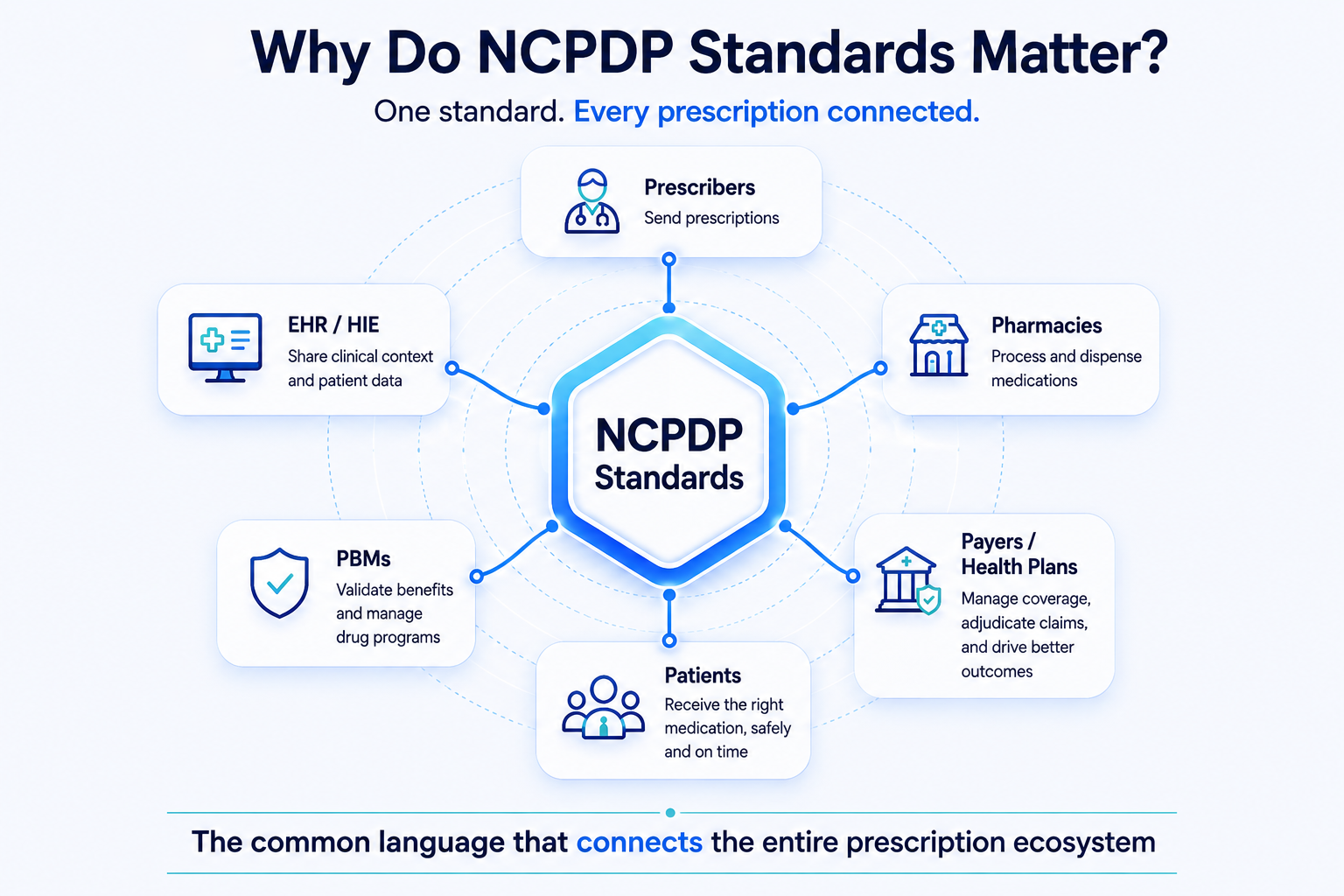
NCPDP standards matter because they provide a common framework for exchanging prescription-related information consistently across healthcare systems, reducing interoperability challenges while improving efficiency and patient safety.
Healthcare organizations rarely operate on a single technology platform. Electronic health records (EHRs), pharmacies, PBMs, payers, and third-party applications all generate prescription-related information, often using different technologies from different vendors.
Without standardized communication, every new integration becomes another custom development project.
National Council for Prescription Drug Program addresses this challenge by defining standardized transaction formats that power modern ePrescribing solutions, medication history, electronic prior authorization (ePA), formulary and benefit information, prescription routing, and pharmacy communication.
Instead of every system speaking its own language, NCPDP standards allow them to exchange information using consistent formats that improve reliability and reduce unnecessary complexity.
This standardization has become one of the key building blocks of modern healthcare interoperability.
What Problems Do NCPDP Standards Solve?
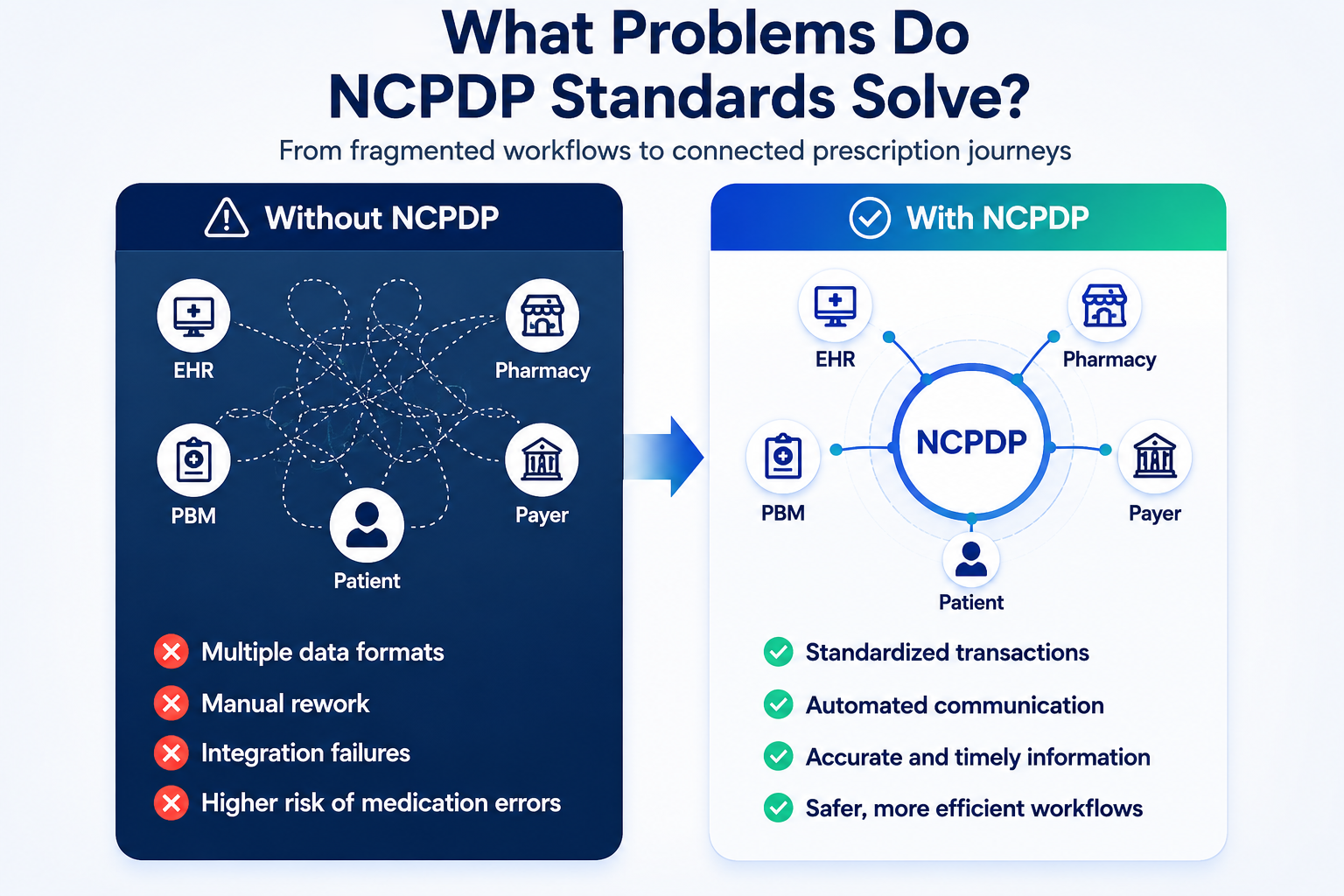
NCPDP standards reduce operational complexity by replacing fragmented prescription workflows with standardized transactions that improve interoperability, prescription accuracy, and regulatory compliance.
Healthcare organizations frequently struggle with disconnected prescription workflows that require manual intervention between clinical and pharmacy systems. These inefficiencies don’t simply affect IT operations; they influence patient care, clinician productivity, and organizational performance.
By standardizing prescription-related transactions, NCPDP helps organizations:
- Reduce manual prescription processing
- Improve communication between EHRs, pharmacies, and PBMs
- Support electronic prior authorization workflows
- Enable more reliable medication history retrieval
- Improve prescription accuracy while reducing administrative burden
Beyond improving today’s workflows, NCPDP standards continue to evolve alongside healthcare technology. Their widespread adoption also highlights how deeply they are embedded in everyday clinical practice.
Updated standards support increasingly sophisticated capabilities such as Real-Time Prescription Benefit (RTPB), richer medication history transactions, and improved electronic prior authorization, helping organizations prepare for the next generation of connected healthcare.
Why Do Healthcare Organizations Still Face Challenges After Adopting NCPDP Standards?
Many healthcare organizations continue to experience interoperability challenges because implementing NCPDP standards alone doesn’t eliminate legacy architectures, fragmented integrations, or inconsistent data governance.
Simply supporting an industry standard does not guarantee seamless interoperability.
NCPDP research also shows that electronic prescribing supported by the SCRIPT Standard can reduce medication errors by at least 55%, demonstrating that meaningful improvements depend not only on adopting the standard but also on implementing it effectively across connected healthcare systems.
Many healthcare organizations still rely on legacy applications that were never designed for today’s connected healthcare environment. Over time, years of custom integrations, multiple interface engines, and evolving regulatory requirements create an increasingly complex technology landscape.
As a result, IT teams often spend more time maintaining integrations than enabling innovation.
The organizations achieving the best outcomes take a different approach. Rather than viewing NCPDP compliance as a one-time implementation project, they build standards-based architectures that simplify future integrations, improve scalability, and reduce long-term technical debt.
What Should Healthcare IT Leaders Prioritize?
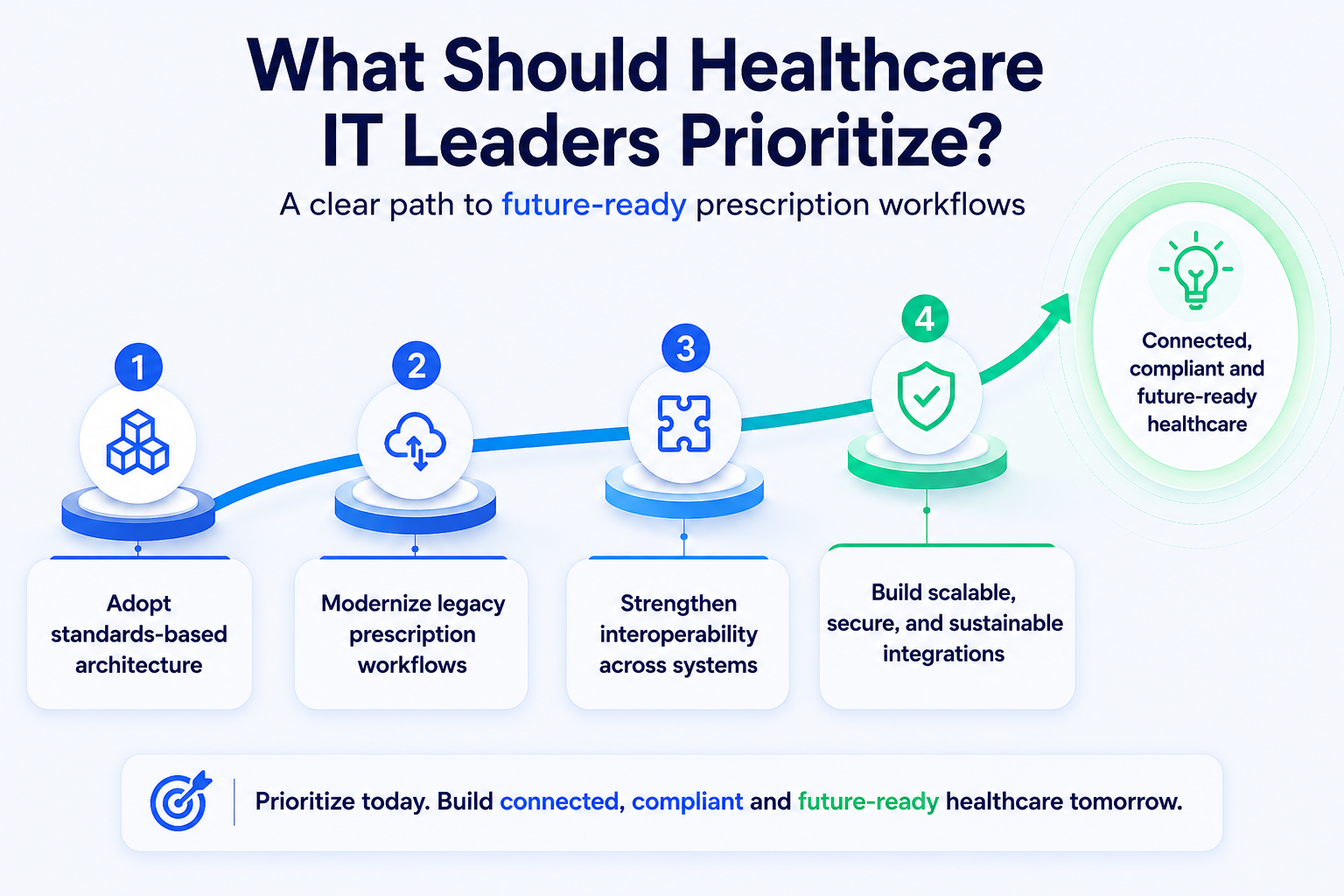
Healthcare IT leaders should treat NCPDP standards as part of a broader interoperability strategy rather than a standalone compliance requirement.
Meeting today’s regulatory requirements is important, but the real value of NCPDP standards lies in preparing healthcare organizations for tomorrow’s digital health ecosystem.
As healthcare organizations expand services, onboard new pharmacy partners, adopt AI-enabled clinical applications, or introduce new patient engagement capabilities; prescription workflows become increasingly interconnected. Technology decisions made today can either simplify future integrations or add years of unnecessary complexity.
Healthcare IT leaders should focus on four priorities:
- Adopt standards-based architectures instead of relying on custom point-to-point integrations.
- Plan for evolving NCPDP standards rather than implementing only the minimum required versions.
- Strengthen interoperability across EHRs, PBMs, pharmacies, and payer systems.
- Modernize legacy prescription workflows before they become barriers to innovation.
Organizations that view NCPDP as a long-term interoperability strategy and not simply a compliance checklist are better positioned to adapt to changing regulations and future healthcare technologies.
NCPDP Readiness Checklist: Is Your Organization Prepared?
Healthcare organizations can use this checklist to quickly assess whether their prescription ecosystem is ready to support evolving NCPDP standards and future interoperability initiatives.
Before planning your next modernization initiative, ask whether your organization can answer “Yes” to the following questions:
✔ Do your prescription workflows support current NCPDP standards?
✔ Can your EHR, pharmacy, PBM, and payer systems exchange prescription data with minimal manual intervention?
✔ Are medication history, ePA, and related transactions integrated into clinical workflows?
✔ Can your current architecture support future NCPDP updates without extensive redevelopment?
✔ Do you have visibility into integration performance, transaction failures, and interoperability issues?
If the answer is “No” to any of these statements, your organization may benefit from reviewing its interoperability strategy and modernization roadmap before future regulatory and technology changes increase integration complexity.
How Logisolve Helps Healthcare Organizations Navigate NCPDP Standards
Healthcare organizations need more than compliance with industry standards. They also need experienced healthcare consulting designing interoperable prescription workflows that can adapt, as healthcare technology and regulatory requirements continue to evolve.
This is where Logisolve adds value. Logisolve helps healthcare organizations modernize legacy ePrescribing platforms and develop interoperable healthcare solutions that support NCPDP standards, medication history, electronic prior authorization (ePA), and prescription workflow modernization.
By helping organizations strengthen interoperability across the prescription ecosystem, Logisolve enables more connected, scalable healthcare technology platforms.
Ready to build a more interoperable prescription ecosystem?
FAQs
1. What are the most commonly used NCPDP standards in healthcare?
The most commonly used NCPDP standards include SCRIPT for electronic prescribing, Telecommunication for pharmacy claims processing, Formulary & Benefit for medication coverage information, and Real-Time Prescription Benefit (RTPB) standards. Together, they enable healthcare organizations to exchange prescription-related information consistently while improving interoperability, patient safety, and operational efficiency.
2. How often are NCPDP standards updated?
NCPDP standards do not follow a single update schedule, but the organization conducts standards work through quarterly work-group meetings and publishes approved standards updates throughout the year. NCPDP’s Data Dictionary and External Code Lists are updated quarterly, while new standard versions or releases are published as they are approved. Healthcare IT teams should monitor NCPDP releases and regulatory timelines to keep implementations current.
3. What should healthcare organizations consider before upgrading to a newer NCPDP standard?
Before adopting a newer NCPDP standard, healthcare organizations should evaluate system compatibility, integration dependencies, vendor readiness, and regulatory requirements. A well-planned upgrade strategy helps minimize workflow disruptions while ensuring new standards can be implemented without introducing unnecessary technical debt or operational risk.
4. How do NCPDP standards support healthcare innovation?
NCPDP standards support healthcare innovation by providing a standardized foundation for emerging technologies such as AI-powered clinical decision support, real-time benefit checks, and advanced medication management. Because systems exchange prescription data using consistent formats, healthcare organizations can introduce new digital capabilities without rebuilding existing integrations from scratch.
5. How can healthcare IT leaders prepare for future NCPDP standards?
Healthcare IT leaders should adopt scalable, standards-based architectures instead of relying on custom point-to-point integrations. Investing in interoperability, modern integration frameworks, and flexible prescription workflows makes it easier to adopt future NCPDP standards while reducing long-term technical debt and implementation risk.
6. How do I know if our NCPDP implementation needs modernization?
Your NCPDP implementation may need modernization if prescription workflows rely on manual intervention, integrations are difficult to maintain, or system updates require significant custom development. Frequent transaction failures, limited interoperability, and challenges supporting new NCPDP standards are also indicators that your architecture may no longer meet current business and regulatory needs.
7. How can we reduce the cost and complexity of NCPDP integrations?
The most effective way to reduce integration cost and complexity is to adopt standards-based architecture instead of relying on custom point-to-point interfaces. Modern integration strategies improve interoperability, simplify maintenance, and make it easier to accommodate evolving NCPDP standards without extensive redevelopment or operational disruption.
8. When should a healthcare organization bring in an NCPDP implementation partner?
Healthcare organizations should consider an NCPDP implementation partner when modernizing legacy prescription systems, preparing new standards, or addressing complex interoperability challenges. Bringing in experienced expertise early in the planning process can help reduce implementation risks, accelerate delivery, and establish a more scalable integration strategy.
9. What should we look for as a healthcare technology partner for NCPDP modernization?
A strong healthcare technology partner should combine expertise in NCPDP standards with deep knowledge of healthcare interoperability, ePrescribing, medication history, electronic prior authorization (ePA), and legacy modernization. The right partner should also be able to design scalable solutions that support evolving standards while minimizing long-term technical debt.
10. Can NCPDP modernization be done without disrupting existing prescription workflows?
Yes, with the right modernization strategy, healthcare organizations can upgrade NCPDP capabilities while minimizing disruption to existing prescription workflows. A phased implementation approach, combined with careful testing and standards-based integration, helps maintain business continuity while enabling long-term improvements in interoperability and system performance.