

5 Hidden Data Quality Issues Blocking AI Adoption in Healthcare Organizations
Healthcare AI adoption does not begin with a model. It begins with data that can be trusted. Yet many organizations discover data problems only after an AI pilot is underway and then correcting them becomes expensive and slows deployment.
Poor data quality can contribute to inaccurate predictions, incomplete patient profiles, misleading recommendations, delayed workflows, and AI pilots that struggle to move into production.
These warning signs are easy to miss, especially when data appears usable on the surface:
- Duplicate identifiers
- Inconsistent medication records
- Blank clinical fields
- External data without enough context
According to a recent Healthcare Data Quality Report, 74% of respondents rated their enterprise patient data as mixed or poor. The report also found that 82% rated patient data from external sources as poor or mixed, while 94% expressed concern about its accuracy.
These findings highlight a fundamental challenge for healthcare AI: having access to large amounts of data does not necessarily mean that the data is usable for a specific AI application. Data quality challenges in healthcare can affect how AI systems are trained, evaluated, and used in real-world workflows, making it important to identify consequential gaps early.
Key Takeaways
- Data can be available but still unusable for AI.
- Fragmentation, missing information, duplicates, inconsistent standards, and stale data can undermine model performance.
- AI requires data that is accurate, complete, consistent, timely, traceable, and representative.
- Data quality should be assessed against the intended use case before development.
5 Hidden Data Quality Issues Blocking AI Adoption
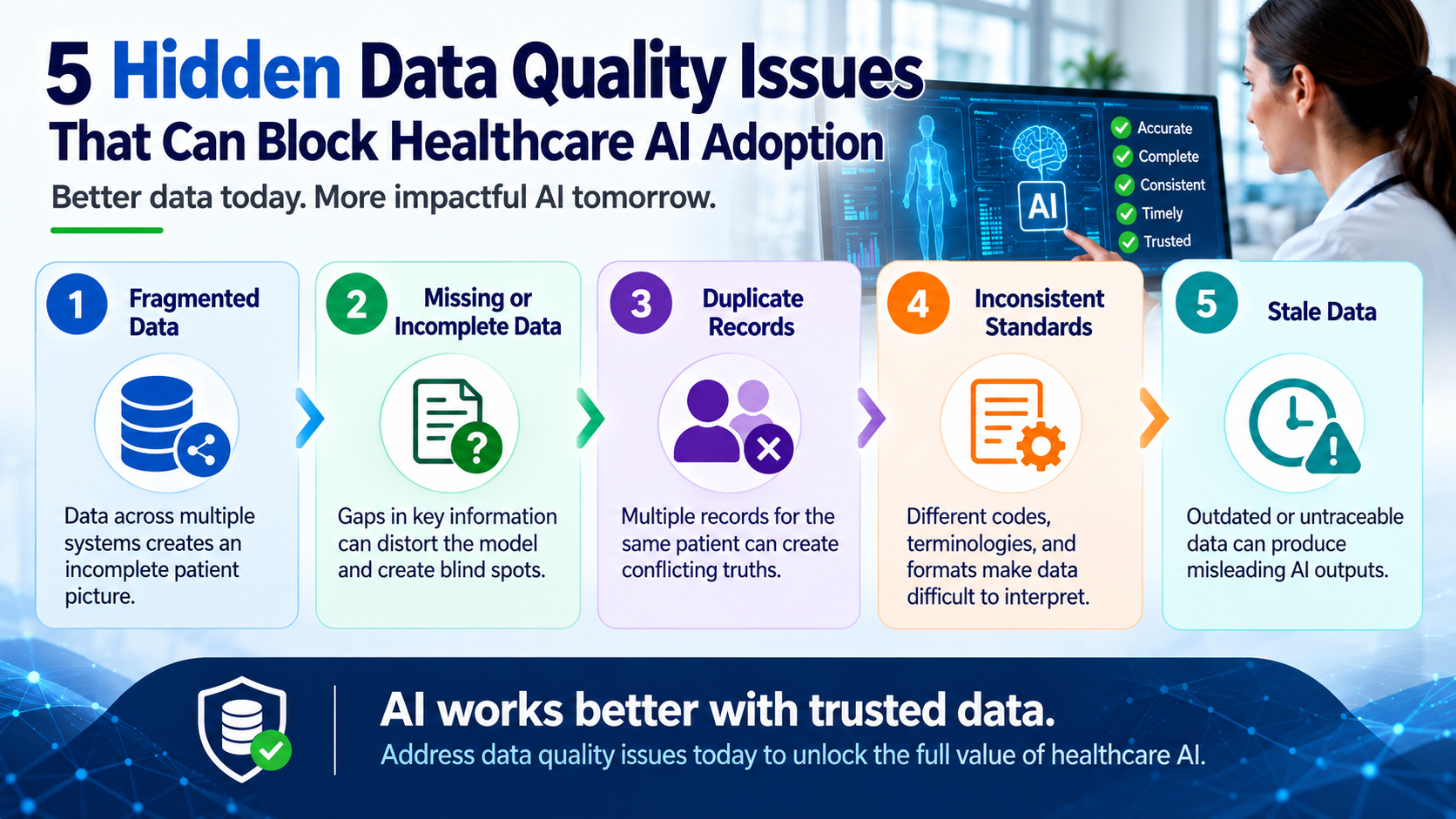
For healthcare AI initiatives, seemingly small data problems can become significant barriers when data is combined, analyzed, or used to support decisions. Poor data quality can affect how AI systems are developed, evaluated, and ultimately used in healthcare workflows. Different types of data-quality issues can create different risks across the AI lifecycle.
The five issues below deserve particular attention.
1. Fragmented Data Creates an Incomplete Patient Picture
Healthcare data often sits across EHRs, claims, pharmacy, laboratory, imaging, and other systems. Information may arrive at different times or in different structures.
An AI system that cannot access relevant clinical context may produce an incomplete result. This matters when medication, allergy, diagnosis, or utilization information is distributed across systems. Organizations with integration debt may need to address architecture before scaling AI.
What to do: Map where critical data resides and how it moves across systems before determining whether the data available to the AI use case is complete enough to support reliable outputs.
2. Missing or Incomplete Data Distorts the Model
A field being present in a database does not mean the information is complete enough for AI. Missing diagnoses, medication histories, demographics, clinical observations, or outcomes can create blind spots.
If patient groups or care settings are documented differently, the dataset may not represent the intended population. Leaders should examine how much data is missing, where, and why.
Medication history gaps are important because incomplete records can affect clinical decision support and medication-related analytics.
What to do: Define quality rules for the fields that matter most to the intended use case and monitor completeness across the relevant patient populations.
3. Duplicate Records Create Conflicting Truths
Duplicate patient, provider, medication, or organization records can split information across multiple identities. One patient may have several records containing different medication lists, encounters, or identifiers.
For AI, duplication can distort counts, such as visit or medication frequency, and create contradictory inputs. AWS HealthLake’s July 2026 announcement highlights how duplicate healthcare records can scatter patient information and lead to analytics that count the same patient more than once.
Master data management, identity matching, and reconciliation can help establish a more reliable longitudinal view and reduce the risk of duplicate information affecting AI-driven analytics or patient-risk scoring.
What to do: Strengthen identity matching and reconciliation processes for the data sources that are most important to the intended AI use case.
4. Inconsistent Standards Make Data Difficult to Interpret
The same clinical concept may be represented differently across systems. Terminology, codes, units, dates, identifiers, and transaction formats can vary by application or organization.
Standards such as FHIR and NCPDP can help systems exchange information consistently, but adopting a standard does not automatically make historical data clean. Organizations still need normalization, mapping, validation, and terminology governance.
For prescription workflows, NCPDP standards can help identify where inconsistent pharmacy data may affect downstream AI.
What to do: Standardize terminology, codes, units, and formats across the data sources that feed the AI use case, while validating how historical data is mapped.
5. Stale or Untraceable Data Weakens Trust
AI also depends on knowing when data was generated, where it came from, and whether it remains relevant. An outdated medication or claims record can produce a misleading output.
Data lineage is critical. Teams should trace important data to its source, transformation steps, and refresh time.
What to do: Define freshness requirements for the use case and maintain sufficient data lineage to identify where important information came from, how it was transformed, and when it was last updated.
Key Data Considerations to Validate Before Developing Healthcare AI
Before approving an AI initiative, healthcare leaders should evaluate whether the data supporting the use case is fit for purpose.
The National Institute of Standards and Technology (NIST’s) Supporting AI in Healthcare publication identifies accuracy, completeness, consistency, relevance, and timeliness as important qualities for healthcare data used with AI.
A focused assessment should answer five questions:
- Coverage: Does the required data exist across the relevant systems and patient populations?
- Quality: Are important fields accurate, complete, consistent, and sufficiently reliable?
- Context: Can teams understand what the data represents, where it came from, and how it was transformed?
- Interoperability: Can information from different systems be combined without losing important meaning or context?
- Timeliness: Is the data current enough for the decisions and workflows the AI solution will support?
The goal is not to clean every dataset before starting an AI project. It is to identify the data issues most likely to affect the specific use case, address the highest-impact gaps, and establish a way to monitor data quality as the initiative progresses.
That gives leaders a stronger basis for deciding whether to move into model development, address foundational data issues first, or narrow the AI use case.
How Logisolve Helps Healthcare Organizations Build AI-Ready Data
Logisolve helps healthcare organizations translate data-quality assessments into the technical foundation needed for AI implementation. It can support organizations in addressing data, integration, architecture, and governance requirements across the AI lifecycle.
Its capabilities address challenges such as fragmented data, inconsistent information, weak data lineage, and unprepared data for analytics and AI initiatives. These capabilities span data transformation, data architecture, integration, analytics, AI and machine learning, and governance, helping organizations connect data sources, improve data quality, and establish appropriate controls.
For healthcare organizations, the objective is to move from data that is merely available to data that is usable, governed, and fit for the AI initiative being developed.
Looking to strengthen your data foundation for AI?
FAQs
1. Why is fragmented healthcare data a problem for AI?
Fragmented data makes it harder to create a complete and consistent view of the information an AI system needs. Healthcare data may exist across EHRs, clinical applications, claims systems, warehouses, and other platforms. Connecting these sources appropriately can help reduce gaps and improve the usefulness of AI-ready data.
2. Does having large amounts of healthcare data mean an organization is ready for AI?
No, having large volumes of healthcare data does not necessarily mean the data is suitable for AI. Data may still be fragmented, incomplete, inconsistent, outdated, or difficult to access appropriately. Organizations should evaluate data quality and usability against the specific problem they intend AI to address.
3. How long does it take to prepare healthcare data for AI?
The timeline depends on the organization’s data environment, the complexity of the AI use case, and the number of systems involved. A focused use case may require less preparation than an enterprise-wide initiative involving multiple clinical and operational data sources. Organizations should assess the existing environment first rather than assume a fixed preparation timeline.
4. Can AI tools fix poor-quality healthcare data?
AI can assist with tasks such as identifying patterns, classifying information, or supporting data normalization, but it should not be treated as a substitute for data-quality management. Poorly structured or unreliable data can still affect downstream results. Organizations should establish appropriate data-quality processes before relying on AI to improve or transform their data.
5. How does healthcare data quality affect AI bias?
Poor-quality or incomplete data can contribute to biased AI outputs when important patient populations or relevant characteristics are underrepresented. Data quality alone does not determine whether an AI system is biased, but it is an important part of evaluating model reliability and fairness. Organizations should examine whether the data represents the population and use case appropriately.
6. What is the difference between data quality and data governance in healthcare?
Data quality focuses on whether information is accurate, complete, consistent, timely, and fit for its intended use. Data governance establishes the policies, ownership, responsibilities, access rules, and processes used to manage that information. Both are important because high-quality data is difficult to maintain without clear accountability and governance.
7. What makes healthcare data different from data used in other industries?
Healthcare data is more complex because it combines clinical, administrative, financial, and patient-generated information from systems with different structures and purposes. It also contains sensitive information requiring appropriate privacy, security, and governance controls, making data quality, context, and interoperability especially important for AI.
8. Can healthcare AI work with data stored across multiple systems?
Yes, healthcare AI can work with data stored across multiple systems when the data can be appropriately accessed, mapped, standardized, and integrated. EHRs, claims platforms, and clinical applications may use different formats and identifiers, making it important to address these differences before development.
9. How does unstructured clinical data affect AI development?
Unstructured clinical data, such as clinical notes and reports, can contain valuable information that may not be captured in structured fields. However, extracting and interpreting that information can require additional processing and validation, increasing the complexity of preparing reliable inputs for healthcare AI.