

Why Healthcare AI Projects Fail Before the First Model Is Deployed
Healthcare AI projects often fail before the first model is deployed because organizations rush to adopt the technology without first addressing the underlying business problem, establishing a solid data foundation, and meeting the necessary governance, workflow, and integration requirements around it.
For IT Directors and Product Leaders, the biggest risk is not always choosing the wrong model. It can be starting an initiative before the organization is ready to operationalize it.
Healthcare AI adoption is accelerating. The American Medical Association reported that 81% of physicians were using AI in their practices in 2026, more than double the 38% reported in 2023. At the same time, 88% identified safety and efficacy validation as critical to adoption. This growing adoption makes organizational readiness increasingly important.
Key Takeaways
✔ AI initiatives should begin with a defined business or clinical problem, not model selection.
✔ Data availability does not automatically mean data is ready for AI.
✔ Governance, accountability, and workflow design need to be addressed before development.
✔ Integration can determine whether a successful model becomes a usable solution.
✔ AI readiness is an organizational capability, not a standalone technology project.
Where Healthcare AI Projects Start to Break Down
Healthcare AI projects can start breaking down long before a model enters development. Four foundational issues tend to determine whether an AI initiative is ready to move forward:
1. The First Failure Point Is Often the Use Case
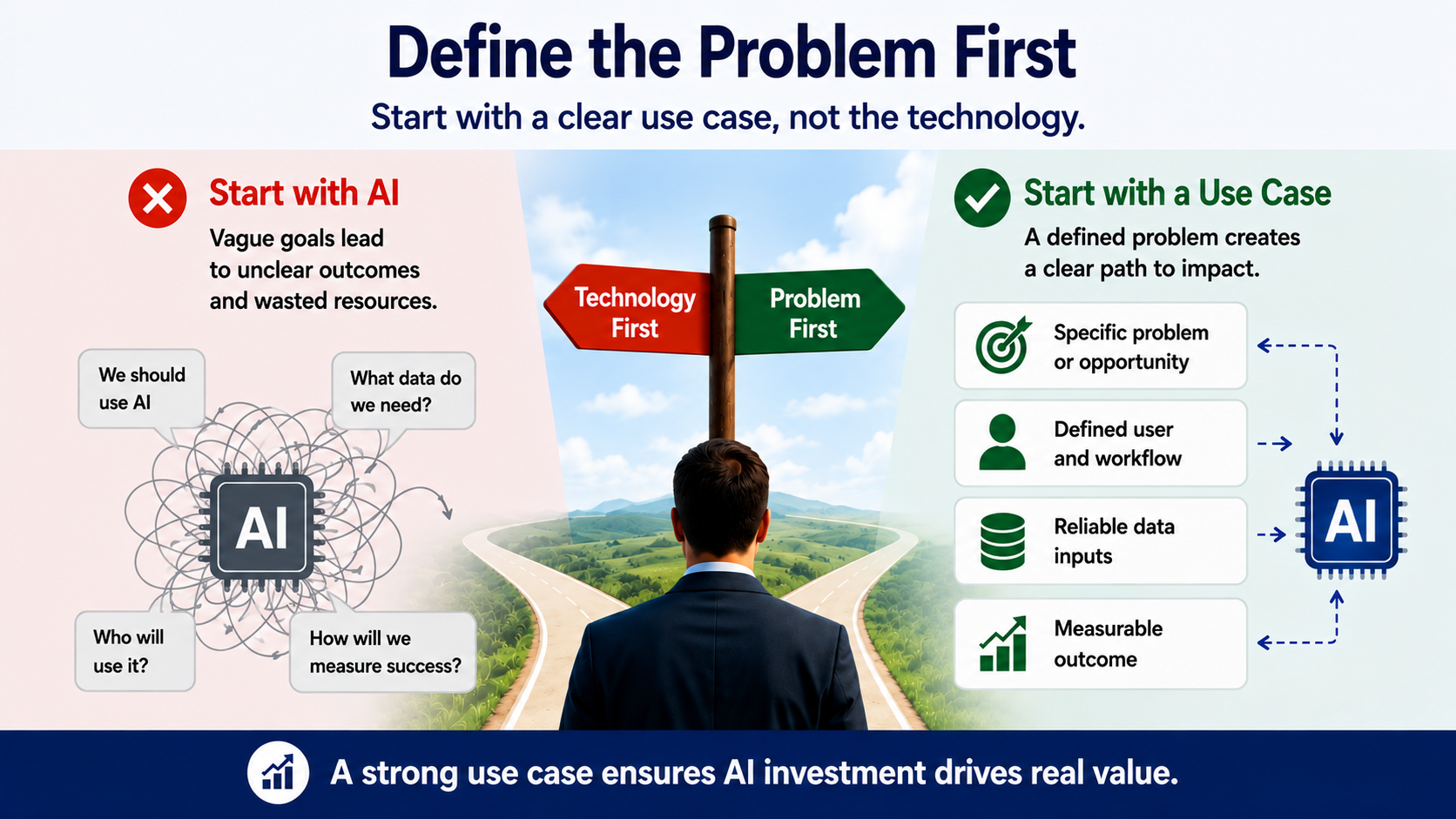
AI projects become difficult when the organization starts with a technology capability instead of a clearly defined problem. A goal such as “use AI to improve patient care” does not establish who will use the output, what decision it will support, what data is required, or how success will be measured.
A stronger use case connects:
- A specific business or clinical problem
- A defined user and workflow
- Reliable data inputs
- A measurable outcome
This discipline helps healthcare leaders determine whether an initiative deserves investment.
2. Data Readiness Determines What Can Actually Be Built
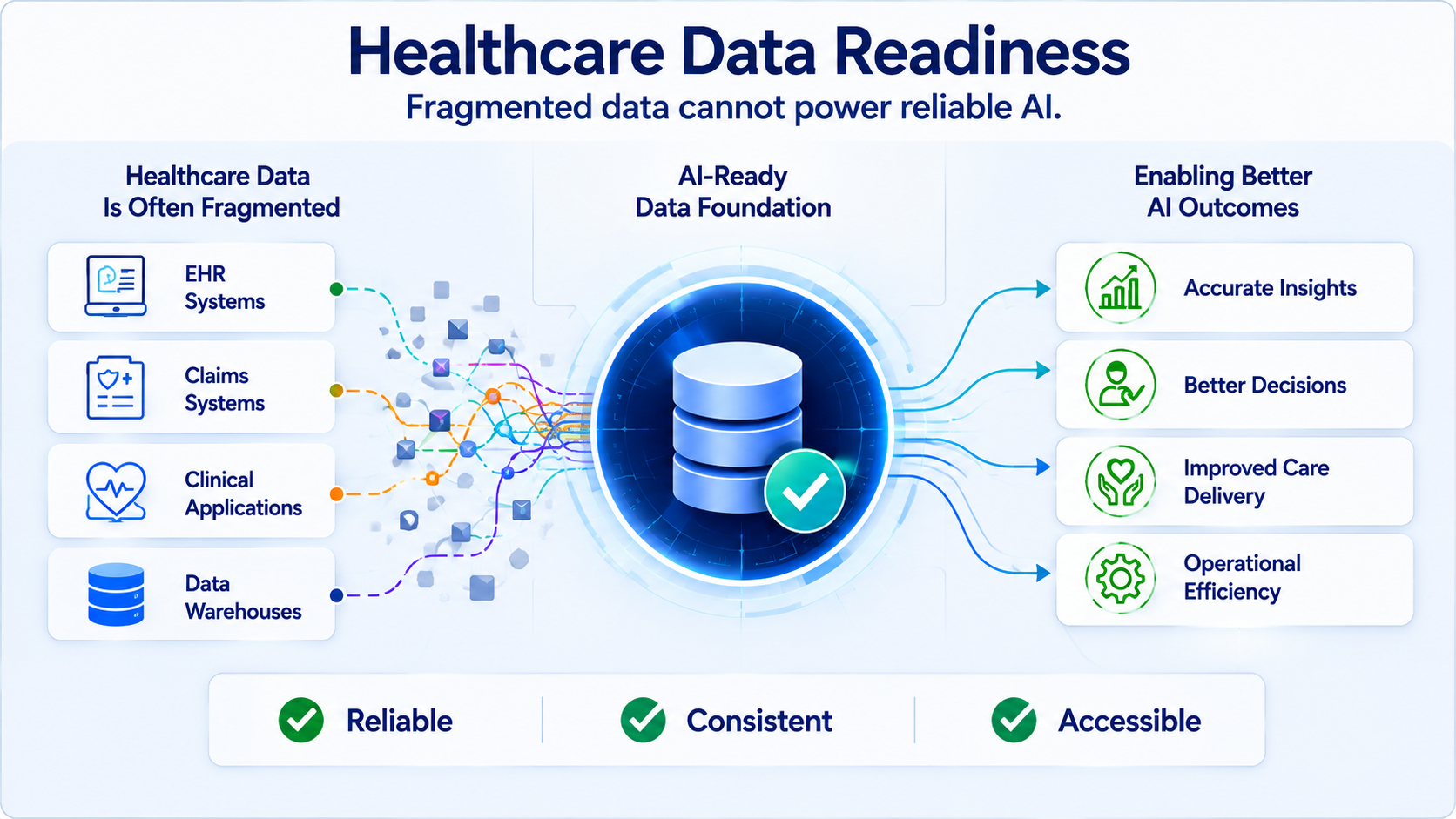
Healthcare organizations may have enormous volumes of data and still lack the foundation required for AI. Information can be distributed across EHRs, claims systems, clinical applications, data warehouses, and other platforms, with differences in structure, ownership, quality, and accessibility.
Medication history gaps are one example of what can happen when clinically important information is distributed across systems and is difficult to access consistently.
Before development, teams should know whether the necessary data exists, can be accessed responsibly, and is consistent enough for the intended use case.
3. Governance Has to Start Before Development
Governance should not appear as a final approval step after a model has been built. Healthcare organizations need to establish responsibility for data access, privacy, security, validation, human oversight, monitoring, and accountability early in the initiative.
The AMA reported that 85% of physicians wanted to be consulted or directly involved in AI adoption decisions in 2026. AI adoption is not purely an IT decision. The people who use and oversee technology need a role in defining it.
Governance must also extend beyond initial approval. Performance, risks, and workflows can change after deployment, requiring ongoing review.
4. Integration Determines Whether AI Becomes Usable
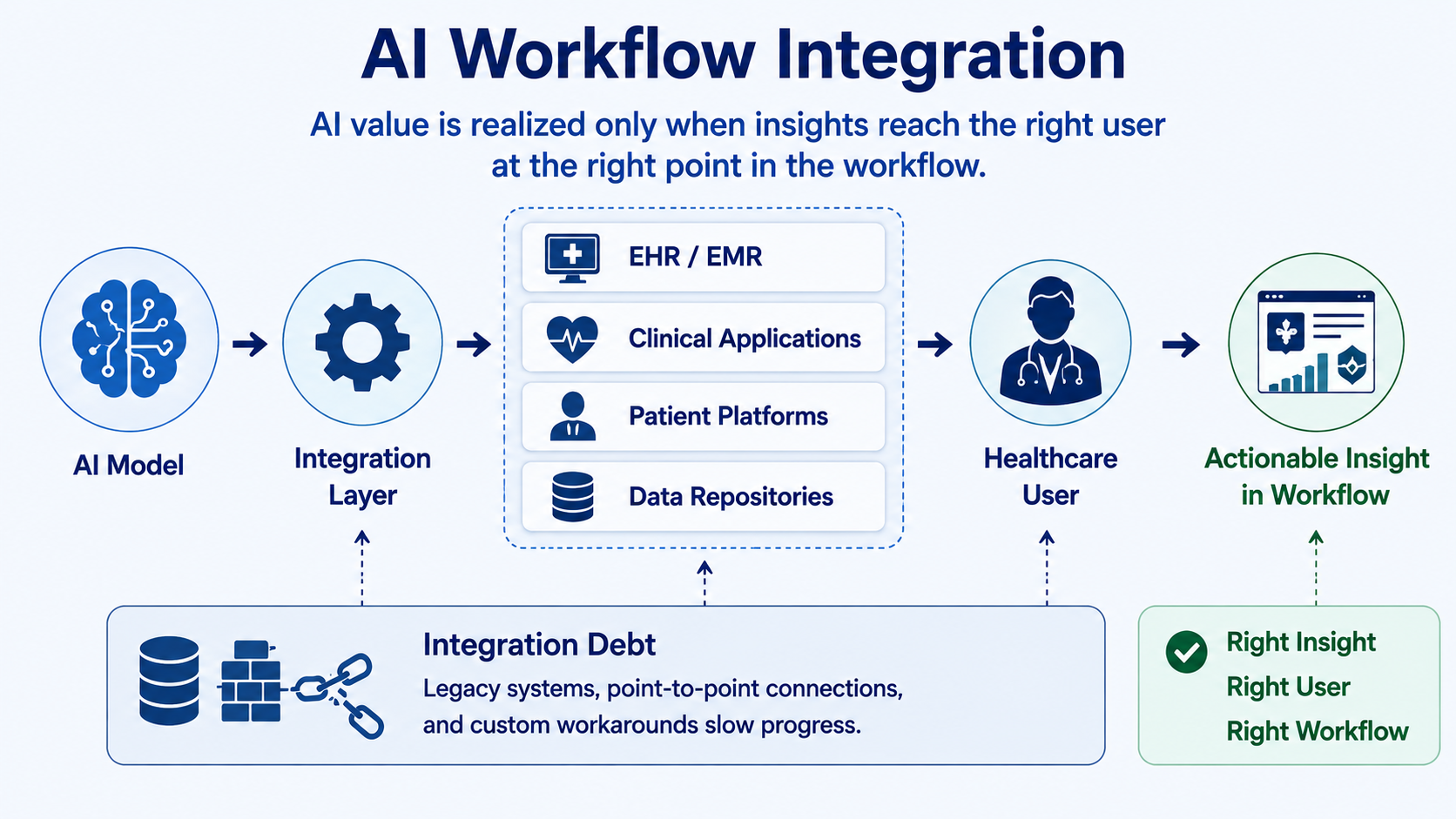
A model can perform well in testing and still fail to deliver value if its output does not fit the workflow. Healthcare AI may need to connect with EHRs, clinical applications, patient platforms, data repositories, and other enterprise systems.
Most physicians consider EHR integration important for advancing AI adoption. For organizations working across complex or legacy environments, accumulated integration debt can make these connections harder to modernize. Integration should therefore be considered during AI planning rather than treated as a task after model development.
For IT Directors and Product Leaders, the test is simple: Can the right user receive the right AI-supported insight at the right point in the workflow without creating additional friction?
These four failure points provide the foundation for a broader AI readiness assessment, which also considers whether users can act on AI outputs within existing workflows.
A Practical AI Readiness Framework
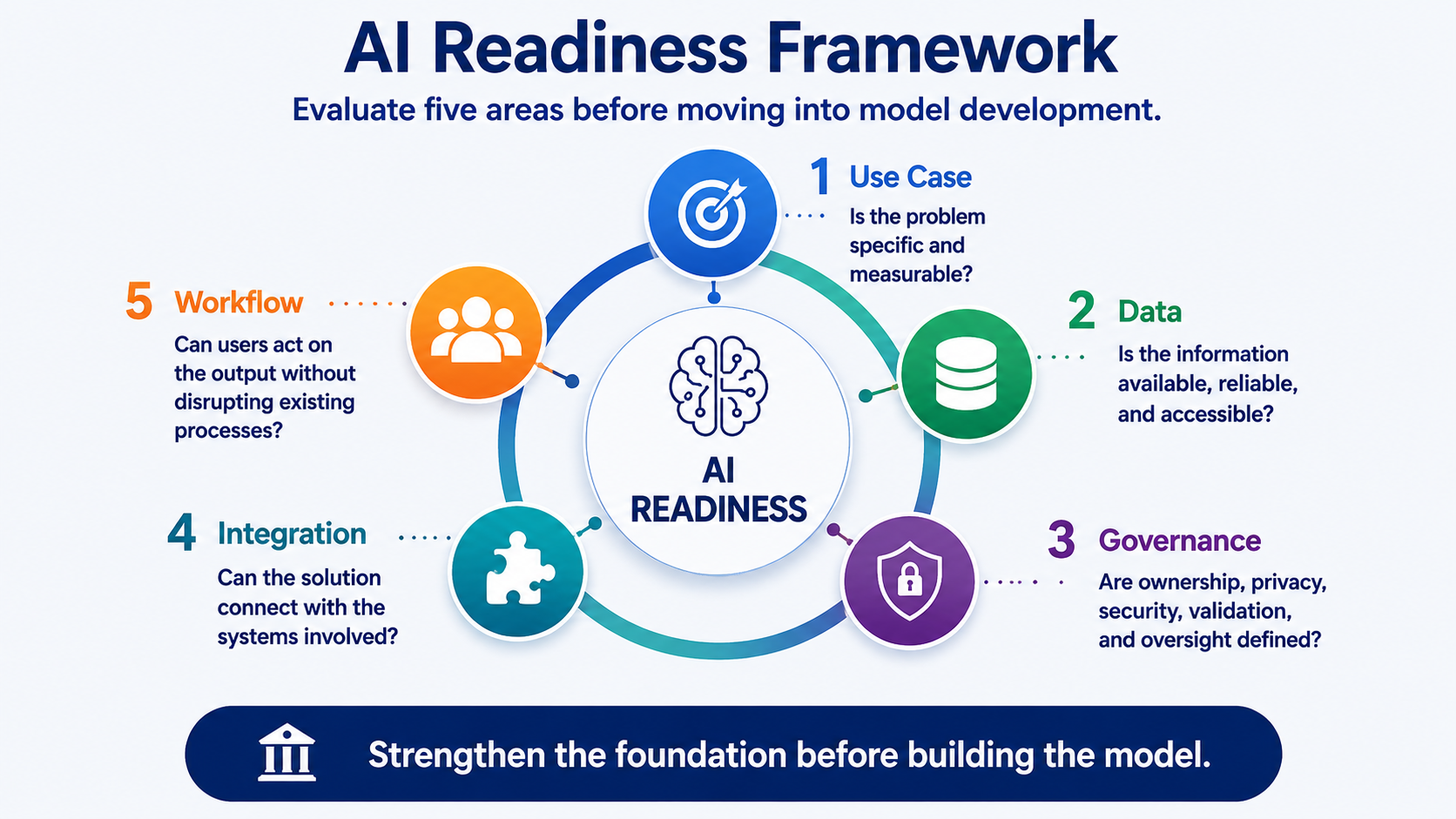
Before moving into model development, leaders can evaluate five areas:
1. Use case: Is the problem specific and measurable?
Define the business or clinical problem the AI initiative is expected to address, who will use the output, and what improvement would indicate success. A clearly defined use case also helps teams determine whether AI is the right solution in the first place.
2. Data: Is the information available, reliable, and accessible?
Assess whether the data needed for the use case exists in sufficient volume and quality and can be accessed appropriately. Teams should also identify gaps, inconsistencies, duplication, and fragmented sources that could affect development or future performance.
3. Governance: Are ownership, privacy, security, validation, and oversight defined?
Establish who is responsible for the data, AI system, validation, and ongoing monitoring before development begins. Governance should also address privacy, security, human oversight, and how changes in data or model performance will be managed.
4. Integration: Can the solution connect with the systems involved?
Determine how the AI solution will exchange information with EHRs, clinical applications, data platforms, or other systems involved in the workflow. Identifying these requirements early can prevent integration work from becoming a barrier after the model is developed.
5. Workflow: Can users act on the output without disrupting existing processes?
Determine where the AI output will appear, who will use it, and what action it is expected to support. The solution should fit naturally into existing processes rather than creating additional steps that make adoption more difficult.
If several answers are unclear, the next investment may need to strengthen the foundation before expanding the AI initiative.
How Logisolve Helps Build the Foundation
Healthcare AI requires more than model development. It requires connected data, systems, workflows, and healthcare expertise.
Logisolve’s Data Transformation practice covers data architecture, governance, analytics, AI, machine learning, and data and systems integration. Our healthcare consulting practice brings experience across clinical messaging, healthcare digitization, EHR systems, pharmaceutical processing, and regulatory and compliance initiatives.
This combination allows Logisolve to approach AI from both the technology and healthcare sides, addressing the data, integration, and workflow environment needed to support adoption and scale.
Still evaluating your healthcare AI readiness?
FAQs
1. Should healthcare organizations build or buy AI solutions?
The decision to build or buy depends on the use case, data environment, technical capabilities, resources, and long-term strategy. Buying can provide faster access to established capabilities, while building may offer greater control over specific requirements. Both approaches still require governance, integration, validation, and workflow planning.
2. Why is EHR integration important for healthcare AI?
EHR integration is important because AI insights need to reach clinicians within the systems and workflows they already use. If AI operates separately from clinical applications, users may need additional steps to access its output, which can reduce adoption and limit its practical value.
3. What should IT leaders evaluate before selecting an AI technology partner?
IT leaders should evaluate a partner’s healthcare expertise, data capabilities, integration experience, governance approach, and ability to connect AI with existing workflows. The right partner should understand the organization’s business problem and technology environment rather than focusing only on model development.
4. How can healthcare organizations move AI from a pilot to production?
Moving AI from pilot to production requires reliable data pipelines, system integration, governance, security, workflow alignment, user adoption, and ongoing performance monitoring. Proving that a model works is only one part of the process; organizations also need the operational foundation to support it after deployment.
5. How much does it cost to implement AI in healthcare?
The cost depends on the use case, data environment, AI solution, integration needs, and infrastructure. Organizations should also consider ongoing costs for maintenance, monitoring, security, and training when estimating the total investment.
6. How do you measure ROI from healthcare AI implementation?
ROI can be measured through improvements such as reduced administrative effort, faster workflows, better resource utilization, or improved outcomes. Organizations should establish baseline metrics and success criteria before implementation to measure the value delivered over time.
7. What infrastructure is needed to implement AI in healthcare?
Healthcare AI requires reliable data sources, secure data pipelines, computing resources, integration capabilities, and systems for monitoring AI applications. Requirements vary based on the use case, data volume, deployment model, and existing technology environment.
8. How do healthcare organizations ensure AI complies with HIPAA requirements?
Organizations should evaluate how AI systems create, receive, maintain, or transmit protected health information and apply appropriate HIPAA privacy and security safeguards. This includes risk analysis, access controls, authentication, audit controls, transmission security, and appropriate policies and procedures. Covered entities should also assess business associate relationships and contractual requirements when third parties handle protected health information.